Listen to this Post
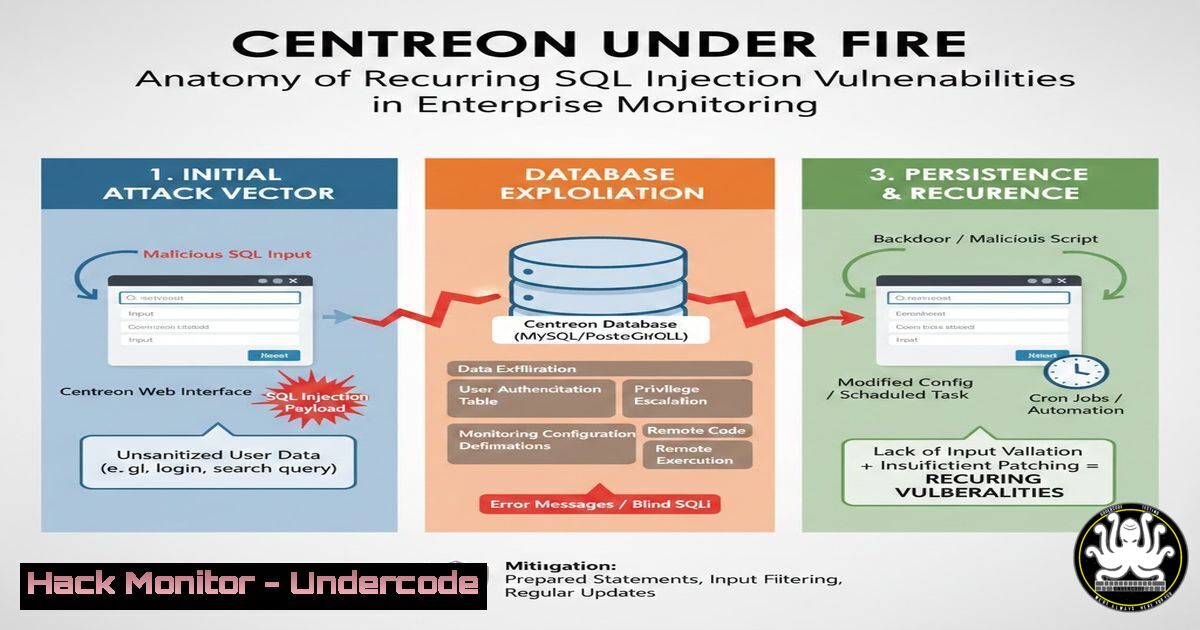
Introduction:
Centreon, a widely adopted IT infrastructure monitoring solution, has recently become a focal point for security researchers due to a series of critical SQL Injection (SQLi) vulnerabilities. A recent responsible disclosure highlighted two new High-severity flaws (CVSS 8.8) in Centreon Web v23.4.0, sparking discussions in the cybersecurity community about the platform’s secure coding practices . Given Centreon’s privileged position within networks—often holding sensitive configuration data and credentials—these vulnerabilities represent a significant supply chain risk. This article analyzes the technical patterns of these flaws, provides actionable commands for detection and mitigation, and outlines what defenders must do to secure their monitored environments.
Learning Objectives:
- Understand the recurring SQL Injection patterns across different Centreon modules and versions.
- Learn to use command-line and database tools to detect Indicators of Compromise (IOCs) related to SQLi exploitation.
- Master step-by-step mitigation techniques, including patching, input sanitization, and WAF rule configuration.
You Should Know:
1. The Disclosure and Recurring Vulnerability Pattern
The recent findings by researcher Mattéo B. involve two SQL Injection vulnerabilities submitted to Centreon’s Vulnerability Disclosure Program (VDP) . While technical specifics are embargoed until patches are released, historical data shows a troubling trend. Vulnerabilities like CVE-2024-23119 affect Centreon Web versions prior to 22.10.17, 23.04.13, and 23.10.5, allowing authenticated attackers to execute arbitrary SQL commands . More critically, recent flaws such as CVE-2025-15029 in the “Awie export module” allow unauthenticated attackers to achieve the same result, elevating the risk to a CVSS score of 9.8 . This indicates that the issue is not isolated to legacy code but persists in newer features like the Meta Service indicator page and virtual metric creation forms .
Step‑by‑step guide: Identifying Vulnerable Centreon Instances
To determine if your Centreon server is potentially vulnerable to the class of bugs disclosed (injections in export modules and configuration forms), you must first check the version and then audit the database user privileges.
– Check Centreon Version via Command Line (Linux):
 Access the Centreon container or main server
sudo dpkg -l | grep centreon-web
 Or via RPM
rpm -qa | grep centreon-web
 Or check the version file
cat /usr/share/centreon/www/class/centreon.class.php | grep VERSION
– Check MySQL/MariaDB User Privileges:
If an attacker exploits SQLi, they can execute commands based on the database user’s privileges. Centreon typically uses a database user with `FILE` privileges for backup purposes, which can lead to Remote Code Execution (RCE) via writing webshells.
-- Log into MySQL as centreon user
mysql -u centreon -p
-- Check current user privileges
SELECT current_user();
SHOW GRANTS FOR current_user();
-- If you see 'GRANT FILE ON .', the risk of RCE via SQLi is extremely high.
- Exploitation Vectors: From SQLi to Remote Code Execution
While the initial disclosure mentions SQLi, the end goal for attackers is often Remote Code Execution (RCE). Centreon’s architecture facilitates this because the SQLi flaws (like CVE-2024-5725 in the `initCurveList` function) allow attackers to write files to the web root or execute system commands via MySQL’s `INTO OUTFILE` combined with web shells, or via `xp_cmdshell` if Centreon is on a Windows server using a linked server .
Step‑by‑step guide: Simulating a SQLi Check (Authorized Testing Only)
This is a conceptual proof for defenders to understand the attack surface. Never run this on production without explicit authorization.
– Intercept the Request: Using Burp Suite, identify a POST request to endpoints like `/centreon/api/latest/` or configuration forms handling `esc_name` or virtual metrics .
– Time-Based Blind SQLi Payload: Send a request with a modified parameter to test for time delays.
POST /centreon/api/latest/modules/awie/export HTTP/1.1
Host: target-centreon.com
Content-Type: application/json

{
"parameter": "1' WAITFOR DELAY '00:00:05'-- -"
}
Note: `WAITFOR DELAY` is for MSSQL. For MySQL (Centreon’s native DB), you would use ' OR SLEEP(5)-- -.
– Monitor Logs: If the response takes 5 seconds longer, the application is vulnerable. Check the Centreon logs and database logs for this anomalous query.
 Check MySQL slow query log (if enabled)
sudo tail -f /var/log/mysql/mysql-slow.log
3. Privilege Escalation via User Configuration Modules
Several CVEs (e.g., CVE-2025-3872, CVE-2024-39843) highlight a specific danger: a user with high privileges (like an administrator) can manipulate the contact form or user creation requests to escalate privileges further or create backdoor admin accounts . This is a classic “confused deputy” problem where the web application fails to sanitize input when processing trusted users.
Step‑by‑step guide: Hardening Database Input Validation
While you cannot change the source code without patching, you can implement database triggers or views to monitor for anomalous SQL patterns.
– Create a Monitoring Script (Bash): This script searches Centreon’s database logs for common SQLi patterns.
!/bin/bash
 save as sqli_monitor.sh
LOG_FILE="/var/log/mysql/centreon-audit.log"
 Enable general log temporarily for auditing (caution: high I/O)
mysql -e "SET GLOBAL general_log = 'ON';"
mysql -e "SET GLOBAL general_log_file = '$LOG_FILE';"

Search for attack patterns
echo "Searching for SQL injection patterns..."
grep -E "('(\s|.)(OR|AND)(\s|.)'=')|(SLEEP()|(BENCHMARK()|(WAITFOR)" $LOG_FILE > /tmp/sqli_alerts.txt

if [ -s /tmp/sqli_alerts.txt ]; then
echo "ALERT: Potential SQLi attempts found!"
cat /tmp/sqli_alerts.txt | mail -s "Centreon SQLi Alert" [email protected]
fi

Disable general log to save performance
mysql -e "SET GLOBAL general_log = 'OFF';"
4. Mitigation: Patching and Virtual Patching
The primary mitigation is upgrading to the patched versions: for the latest Awie module bug (CVE-2025-15029), upgrade to 25.10.2, 24.10.3, or 24.04.3 . For the Meta Service indicator bug (CVE-2025-4650), upgrade to versions 23.10.26, 24.04.16, or 24.10.9 . However, if immediate patching is impossible, virtual patching via a Web Application Firewall (WAF) is critical.
Step‑by‑step guide: Configuring ModSecurity (WAF) for Centreon
Using ModSecurity with the OWASP Core Rule Set (CRS) can block SQLi attempts.
– Install ModSecurity for Apache/Nginx.
– Enable CRS: Ensure the SQLi rules are active (Rule IDs 942xxx).
– Create a Custom Exclusion/Inclusion Rule: Since Centreon has many input points, you may need to tune rules. Create a custom rule to specifically inspect Centreon paths:
 In /etc/modsecurity/modsecurity.conf or custom rules file
 Block SQLi attempts specifically on Centreon's API and config pages
SecRule REQUEST_FILENAME "@contains /centreon/api" \
"id:1005,\
phase:2,\
deny,\
status:403,\
msg:'Centreon API SQLi Blocked',\
chain"
SecRule ARGS "@detectSQLi" ""
5. System-Level Hardening for Centreon
Beyond patching the web app, the underlying OS and database must be hardened to limit the blast radius of a successful SQLi.
Step‑by‑step guide: Linux & Database Hardening Commands
- Remove Database File Write Privileges: If Centreon doesn’t require backups via SQL, revoke FILE privileges.
REVOKE FILE ON . FROM 'centreon'@'localhost';
FLUSH PRIVILEGES;
- AppArmor/SELinux: Enforce strict profiles for the database daemon to prevent it from writing to web directories.
Check SELinux status
getenforce
Ensure MySQL cannot write to httpd directories
setsebool -P httpd_can_network_connect_db on
Create a custom policy to prevent mysqld from accessing /var/www/html
echo "neverallow mysqld_t httpd_sys_content_t:file write;" > my_sql.te
(Compilation of policies is distribution specific, shown conceptually)
- Network Segmentation: Use `iptables` or `firewalld` to restrict access to the Centreon web interface (ports 80/443) only to trusted management subnets.
sudo firewall-cmd --permanent --add-rich-rule='rule family="ipv4" source address="192.168.management.0/24" port protocol="tcp" port="443" accept'
sudo firewall-cmd --permanent --remove-service=https
sudo firewall-cmd --reload
6. Incident Response: Detecting Post-Exploitation
If an attacker exploited an SQLi (like CVE-2024-55573) to create a webshell, you need to know how to find it .
Step‑by‑step guide: Hunting for Webshells
- Find recently modified PHP files in the webroot:
find /usr/share/centreon/www/ -type f -name ".php" -mtime -7 -ls
- Check for suspicious PHP functions: Attackers often use
system(),exec(), or `eval()` in injected files.grep -rE "(system|exec|shell_exec|passthru|eval)(" /usr/share/centreon/www/ - Audit Apache Logs for POST requests to suspicious files:
sudo cat /var/log/httpd/access_log | grep -E "POST.(eval|cmd|shell).php"
What Undercode Say:
- History Repeats Itself: The pattern of SQL injections in Centreon, ranging from authenticated high-privilege bugs to unauthenticated critical flaws in the Awie module, indicates a persistent failure to implement parameterized queries universally. This is not a one-off bug but a systemic coding oversight .
- Supply Chain Monitoring is Vital: Centreon monitors your entire infrastructure. A compromise here is a “high-value target” attack. Defenders must treat monitoring tools as Tier 0 assets, applying the strictest patching SLAs and network segmentation. The lag between disclosure (like Mattéo B.’s findings) and public patching is a window of opportunity for advanced persistent threats (APTs).
- Defense in Depth is Non-Negotiable: Patching is the solution, but virtual patching via WAFs (ModSecurity), strict database user privileges, and filesystem integrity monitoring (like AIDE or Tripwire) are essential layers to buy time and detect breaches early.
Prediction:
As Centreon continues to evolve its feature set (like the “Awie” and “Meta Service” modules), we predict an increase in vulnerabilities within these newer, less-audited code paths. Attackers will pivot from classic web vectors to exploiting these monitoring-specific modules to gain a foothold in OT and IT networks. The shift towards unauthenticated SQLi (CVE-2025-15029) suggests that future disclosures may not require any user privileges, forcing organizations to isolate their Centreon instances behind VPNs or jump hosts immediately, rather than relying on application-level authentication alone.
▶️ Related Video (84% Match):
🎯Let’s Practice For Free:
IT/Security Reporter URL:
Reported By: Matteo B – Hackers Feeds
Extra Hub: Undercode MoN
Basic Verification: Pass ✅


