Listen to this Post
Introduction:
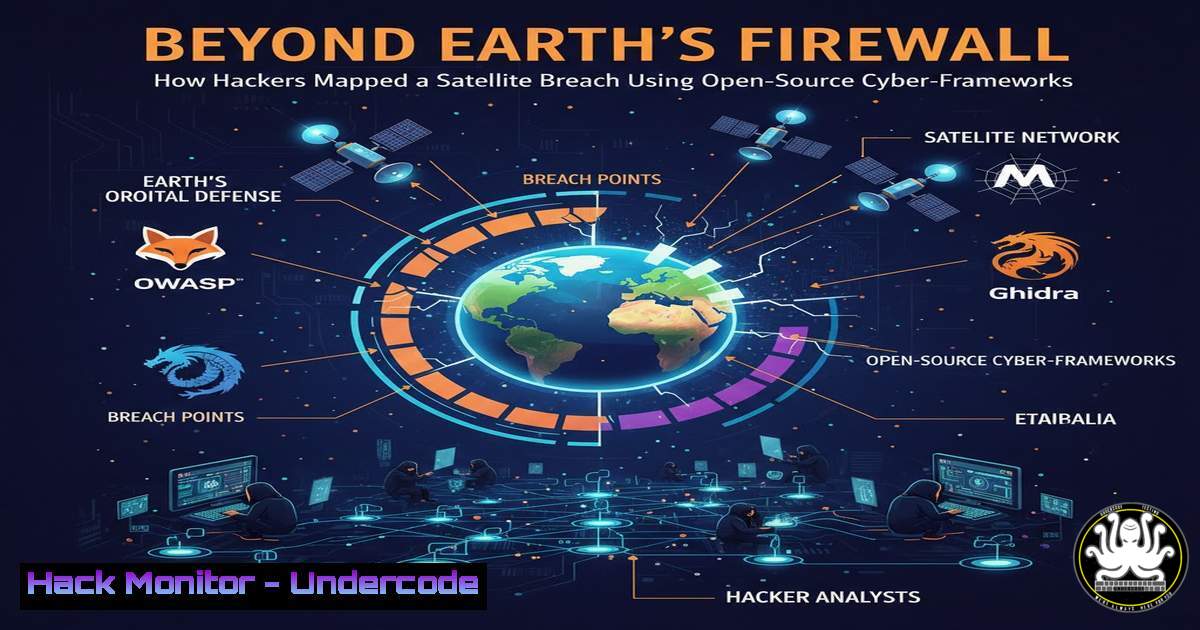
The final frontier is no longer safe from cyber intrusion. A recent collaborative analysis has successfully reverse-engineered a live satellite hacking demonstration using a fusion of specialized frameworks, proving that space system attacks can be modeled, visualized, and defended against using adapted terrestrial cybersecurity methodologies. By integrating the space-specific SPARTA framework with the ubiquitous MITRE ATT&CK® Flow Builder, researchers have created a powerful blueprint for aerospace threat modeling.
Learning Objectives:
- Understand the role of the SPARTA (Space Attack Research and Tactic Analysis) framework in cataloging space-based TTPs.
- Learn how to integrate specialized threat data into the MITRE ATT&CK Flow Builder for visual attack simulation.
- Gain insight into the methodology for mapping a complex, real-world aerospace attack chain from disclosure to visual model.
- Explore the critical importance of open-source tool collaboration in securing emerging technological domains.
- Identify commands and processes for setting up a local threat modeling environment for space systems.
You Should Know:
- The SPARTA & MITRE ATT&CK Fusion: A New Lens for Space Threats
The core of this breakthrough is the integration of two frameworks. SPARTA provides a curated list of Tactics, Techniques, and Procedures (TTPs) specific to space vehicles and ground systems, such as “Jamming” or “Telemetry Forgery.” The MITRE ATT&CK Flow Builder is a tool for visually constructing attack sequences. The PWNSAT team (including researchers Romel Marin and Kevin Jahaziel L.) modified the Flow Builder to natively ingest SPARTA’s data, creating a specialized tool for aerospace cyber visualization.
Step‑by‑step guide:
Step 1: Access the Tools. Clone the pwnsat-modified ATT&CK Flow Builder repository and review the SPARTA framework documentation.
git clone <a href="https://github.com/pwnsat/attack-flow-builder-fork">https://github.com/pwnsat/attack-flow-builder-fork</a>  Example repository
cd attack-flow-builder-fork
Step 2: Environment Setup. The builder typically runs as a web application. Install dependencies using Node.js and launch the local server.
npm install
npm run dev
Step 3: Load SPARTA Data. Within the application, ensure the SPARTA JSON layer or data source is correctly linked. This may involve importing a custom STIX bundle or configuration file that maps SPARTA TTPs to the tool’s ontology.
Step 4: Begin Modeling. Start a new flow. You can now select techniques from both the standard Enterprise ATT&CK matrix and the integrated SPARTA techniques to build attack sequences relevant to satellite systems.
- Deconstructing the Thales CYSAT 2023 Hack: From Demo to Diagram
The subject of the analysis was a satellite hacking demonstration by Thales at the CYSAT 2023 conference. Researchers from The Aerospace Corporation first dissected this demo, mapping each action to corresponding SPARTA TTPs. François Quiquet then used these mapped TTPs as inputs for the PWNSAT-modified Flow Builder.
Step‑by‑step guide:
Step 1: Threat Intelligence Gathering. Obtain the technical analysis of the target incident (e.g., conference whitepaper, disclosure report). In this case, it was the public analysis of the Thales demo.
Step 2: TTP Mapping. Manually or semi-automatically map each attack step to a framework identifier. Example: An attacker’s first step of “Scanning for Open Telemetry Ports” might map to `SPARTA-T1005: Network Reconnaissance` or a similar technique.
Step 3: Chronological Sequencing. Log the TTPs in the order of execution during the attack. This creates a timeline: [Initial Access] ->
 -> [Command Injection] -> [Payload Delivery] -> [bash]</code>.
 Step 4: Visual Assembly. In the Flow Builder, drag and drop the identified TTP nodes onto the canvas, connecting them sequentially to recreate the attack's logical flow. Annotate nodes with specific details from the demo (e.g., "Exploited vulnerable command <code>SAT_CMD_UPDATE</code>").

<ol>
<li>Building Your Own Aerospace Attack Flow: A Practical Tutorial
To apply this methodology to a different scenario, you need a structured approach. This process turns abstract threat intelligence into an actionable defensive diagram.</li>
</ol>

<h2 style="color: yellow;">Step‑by‑step guide:</h2>

Step 1: Define the Scenario. Choose a hypothetical or historical space system incident. Document the asset (e.g., "CubeSat with UHF uplink"), the attacker's goal (e.g., "Orbit Alteration"), and known entry points.
 Step 2: Populate the Data Layer. Ensure your Flow Builder instance has the necessary data. Verify SPARTA techniques are loaded. You may need to add custom techniques for novel threats via the tool's data schema.
[bash]
// Example of a potential custom technique schema addition
{
"id": "custom-space-001",
"name": "Solar Flare-Induced Memory Corruption",
"description": "Adversary times payload delivery to coincide with SEU events.",
"tactic": "initial-access"
}
Step 3: Draft the Flow. Start with the attacker's first actionable step. Systematically add techniques, asking "How would the attacker proceed from here?" Use the connectors to show success/failure branches.
Step 4: Export and Share. Export the completed flow as a JSON (STIX) file or an image. This artifact can be used for briefings, defender training, or as input for security control gap analysis.
- From Visualization to Hardening: Translating the Diagram into Defenses
The primary value of an attack flow is not in its creation but in its use for proactive defense. Each node in the diagram represents a potential detection or prevention point.
Step‑by‑step guide:
Step 1: Identify Critical Nodes. Review your flow. Pinpoint the techniques that are most critical to the attack's success or that offer the best visibility for detection (e.g., "Spoofed Ground Station Signal").
Step 2: Map Existing Controls. For each technique, list existing security controls. For a Linux-based ground station, this might involve checking `iptables` rules or `auditd` configurations for signs of unauthorized access.
 Example: Checking for unusual processes related to telemetry on a Linux ground server
ps aux | grep -E '(telemetry|modem|uhd_)' | grep -v grep
 Reviewing firewall logs for access to the telemetry port (e.g., 5000)
sudo tail -f /var/log/iptables.log | grep :5000
Step 3: Implement Mitigations. For techniques with weak or no controls, implement mitigations. If "Unencrypted Telemetry" is a node, the mitigation is to enforce TLS 1.3 for all uplink/downlink. Update system configurations and policies accordingly.
Step 4: Simulate & Test. Use the flow as a guide for purple team exercises. Have a red team attempt to follow the attack path while the blue team monitors the identified detection points.
- The Imperative of Open Collaboration in Niche Cybersecurity Fields
The successful mapping of the Thales hack was not the work of a single entity but a chain: Thales (demo) -> The Aerospace Corp (SPARTA analysis) -> PWNSAT team (tool integration) -> Quiquet (visual modeling). This underscores a critical paradigm for securing complex systems like space assets.
Step‑by‑step guide for community contribution:
Step 1: Publish Research. Share findings in accessible formats—blogs, whitepapers, conference talks—like the articles linked by Quiquet and Marin.
Step 2: Open-Source Tools. Release tools and integrations, like the modified ATT&CK Flow Builder, under permissive licenses (e.g., MIT, Apache 2.0).
 A good .gitignore for a cybersecurity tool project
node_modules/
.env
.log
config_secret.json
Step 3: Document Extensively. Provide clear `README.md` files, installation guides, and example use cases to lower the barrier to entry for other professionals.
Step 4: Foster Dialogue. Engage on professional networks and at specialized conferences (like CYSAT) to iterate on tools and methodologies based on community feedback.
What Undercode Say:
- Key Takeaway 1: The blending of domain-specific knowledge (SPARTA) with generalized, powerful visualization tools (MITRE ATT&CK) is a force multiplier for securing cutting-edge technologies, from satellites to IoT and industrial AI.
- Key Takeaway 2: The future of defense in highly specialized sectors is inherently collaborative and open-source. Proprietary, siloed security solutions cannot evolve as quickly as the threats targeting these nascent ecosystems.
Analysis:
This case study is a masterclass in modern threat intelligence workflow. It moves from a raw, technical demonstration to a structured, shareable, and actionable model. The technical integration—modifying the Flow Builder to accept a new framework—is a replicable pattern for any niche sector (e.g., maritime, medical). Crucially, it proves that even the most exotic attacks consist of chains of understandable steps. The real victory is not in the diagram itself, but in the established pipeline: when the next satellite vulnerability is disclosed, the community now has a proven, open-source method to rapidly model it, disseminate understanding, and harden systems globally. This significantly raises the cost and complexity for adversaries.
Prediction:
Within the next 2-3 years, this methodology will become standard practice for major aerospace primes and space agencies. We will see the emergence of automated "Attack Flow Compilers" that can ingest natural language incident reports from sources like CVE databases or conference papers and automatically generate preliminary SPARTA-ATT&CK flow diagrams. Furthermore, as satellite constellations grow, these flow models will be integrated directly into Security Orchestration, Automation, and Response (SOAR) platforms for ground segments, enabling automated threat hunting for mapped TTPs and dynamic reconfiguration of virtualized satellite network functions in response to live attacks. The boundary between IT, OT, and space cybersecurity will formally dissolve.
🎯Let’s Practice For Free:
IT/Security Reporter URL:
Reported By: Romel Marin - Hackers Feeds
Extra Hub: Undercode MoN
Basic Verification: Pass ✅


