Listen to this Post
Introduction:
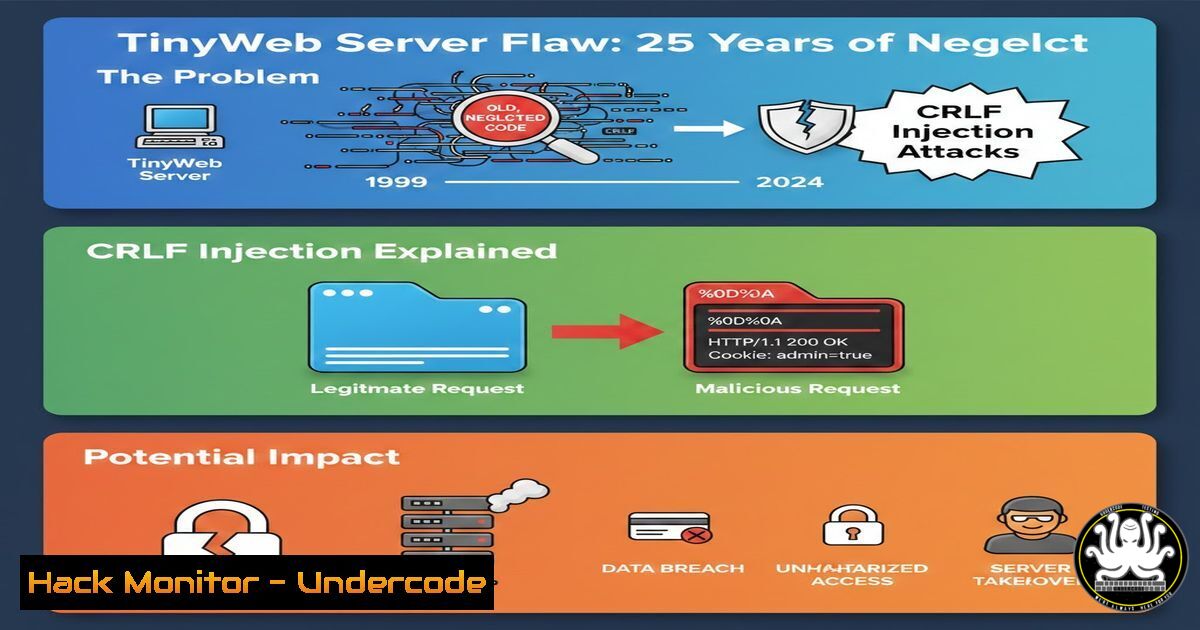
A recently disclosed vulnerability in the TinyWeb HTTP server demonstrates that code rot is a genuine and persistent threat in the cybersecurity landscape. Discovered by researcher Allan Hedegaard, CVE-2024-5193 reveals a CRLF injection flaw present in every software version from 0.5 in 1997 through 1.98. This issue allows attackers to perform HTTP response splitting, leading to Cross-Site Scripting (XSS) and cache poisoning without any authentication, proving that legacy systems remain a soft target for modern exploits.
Learning Objectives:
- Understand the mechanics of CRLF injection (CWE-93) and how it facilitates HTTP Response Splitting.
- Analyze the attack surface of legacy web servers and the importance of supply chain security.
- Learn practical detection and mitigation techniques to secure aging IT infrastructure.
1. Anatomy of the Attack: Understanding CRLF Injection
The core of this vulnerability lies in how the TinyWeb server handles user-supplied input within HTTP headers. CRLF refers to the Carriage Return (\r) and Line Feed (\n) characters, which signify the end of a line in network protocols. When an application fails to sanitize user input and reflects it back in an HTTP header, an attacker can inject these characters to terminate the current header prematurely and start a new one.
What this means for TinyWeb:
An attacker could send a crafted request containing malicious newline characters. Because the server does not validate the input, it interprets the injected characters as a legitimate header split. This allows the attacker to control part of the HTTP response sent to the client.
Linux Command Simulation (using Netcat):
To test for basic CRLF injection on a vulnerable server, you might send a raw request:
 Replace TARGET_IP and PORT with the server details
printf "GET / HTTP/1.1\r\nHost: TARGET_IP\r\nUser-Agent: Mozilla/5.0\r\nInjected-Header: value\r\n\r\n" | nc TARGET_IP PORT
While this example is benign, an attacker would modify the `Injected-Header` section to include malicious syntax.
- From CRLF to XSS: The Response Splitting Exploit
HTTP Response Splitting is the primary weapon derived from this CRLF flaw. By splitting the response, the attacker can inject a second HTTP response. The first response might be partially ignored, while the second is interpreted by the user’s browser as a new, attacker-controlled page.
Attack Workflow:
- The attacker sends a request containing a malicious URL with encoded CRLF characters followed by a fake HTTP response.
- The vulnerable server accepts the request and generates the first, legitimate response header.
- Due to the CRLF injection, the server also processes the attacker’s injected data as a second set of headers and body.
- The browser receives what looks like two responses. It may discard the first (legitimate) one and render the second (malicious) one, leading to XSS or defacement.
3. Identifying Vulnerable Versions (Version Discovery)
The advisory states that versions 0.5 to 1.98 are affected. Identifying these servers in a legacy environment requires banner grabbing.
Windows Command (PowerShell):
 Connect to the port and capture the server banner
$tcpConnection = New-Object System.Net.Sockets.TcpClient('target.server.com', 80)
$stream = $tcpConnection.GetStream()
$writer = New-Object System.IO.StreamWriter($stream)
$writer.WriteLine("HEAD / HTTP/1.1")
$writer.WriteLine("Host: target.server.com")
$writer.WriteLine("Connection: Close")
$writer.WriteLine()
$writer.Flush()
$reader = New-Object System.IO.StreamReader($stream)
$reader.ReadToEnd()
If the server header returns “TinyWeb” with a version between 0.5 and 1.98, it is vulnerable.
4. The Patch Analysis: Upgrading to Version 1.99
The fix was implemented in TinyWeb version 1.99. The developer, Maxim Masiutin, addressed the issue by properly sanitizing input that goes into headers, likely stripping or encoding CR and LF characters.
Verification Steps Post-Patch:
To ensure the patch is effective, security engineers should perform regression testing.
1. Baseline: Confirm the vulnerability exists on version 1.98 using a proof-of-concept script (e.g., using Python requests with `%0d%0a` encoding).
2. Upgrade: Replace the legacy binaries with version 1.99.
3. Validation: Run the same PoC script against the new version. If patched, the injected headers should be neutralized, appearing as plain text in the response or causing a 400 Bad Request error.
5. Mitigation Strategies for Legacy Lock-In
If patching is not immediately possible (due to system downtime constraints or lack of vendor support), virtual patching is required.
Web Application Firewall (WAF) Rule Logic:
You must block requests containing patterns indicative of CRLF injection in headers.
– Regex Pattern to block: `[%0d%0a\r\n]`
– Rule Location: Apply to all request parameters, URIs, and headers.
– Caution: Overly aggressive blocking may impact legitimate traffic that includes newlines in encoded data. It is safer to block requests where these characters appear in specific contexts, like the `Location` or `Set-Cookie` headers.
6. The “Ghost” Risk: Caching Servers and Proxies
One of the most dangerous aspects of HTTP Response Splitting is cache poisoning. If a vulnerable TinyWeb server sits behind a reverse proxy or CDN, an attacker can poison the cache. Once the cache stores the attacker’s malicious page, it serves that page to all subsequent users, turning a single vulnerability into a mass malware distribution point.
Checklist for Infrastructure Security:
- Identify all internet-facing legacy servers.
- Map the traffic flow to identify proxies (Squid, Nginx, Apache) in front of the TinyWeb server.
- Ensure the proxy is configured to strictly validate origin responses and strip ambiguous headers.
What Undercode Say:
This discovery serves as a critical reminder that software does not age like wine, but rather like infrastructure left to rust. The TinyWeb vulnerability is a textbook example of “technical debt” becoming a “security liability.”
- Key Takeaway 1: Inventory is Essential. You cannot secure what you do not know exists. Many organizations still run TinyWeb or similar obscure servers (like older versions of thttpd or Boa) on embedded systems or forgotten development boxes. A rigorous asset discovery process is the foundation of security.
- Key Takeaway 2: Simplicity is Not Security. TinyWeb is known for being lightweight and simple, yet it harbored a basic injection flaw for 25 years. This proves that minimalism does not equal security; secure coding practices and input validation are mandatory regardless of the project’s size.
The broader analysis here highlights the danger of “zombie code”—software that continues to run without active maintenance. While the CVSS score is a “Medium” 5.3, the actual business impact could be critical if this server handles sessions or sits behind a cache. Security teams must treat legacy components with the highest suspicion, applying defense-in-depth until they can be decommissioned or modernized.
Prediction:
Following this disclosure, we will likely see a resurgence in scanning for tiny, embedded web servers. Threat actors will weaponize this CVE to target industrial control systems (ICS) and IoT devices, where stripped-down HTTP servers like TinyWeb are common. This will lead to a wave of firmware analysis in 2025, revealing similar injection flaws in end-of-life hardware, forcing manufacturers to issue rare patches or lose market trust.
▶️ Related Video (82% Match):
🎯Let’s Practice For Free:
IT/Security Reporter URL:
Reported By: Allan Hedegaard – Hackers Feeds
Extra Hub: Undercode MoN
Basic Verification: Pass ✅


