Listen to this Post
Introduction
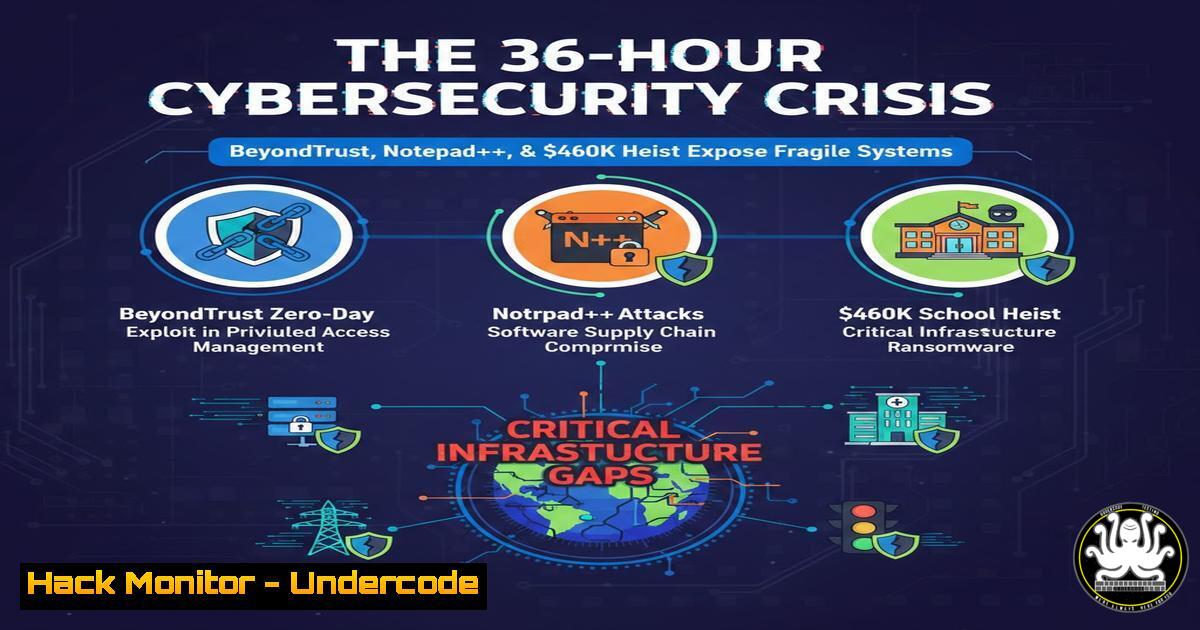
The cybersecurity landscape has shifted dramatically in the past 36 hours, with three major incidents demanding immediate attention from security professionals worldwide. A critical BeyondTrust remote access vulnerability (CVSS 9.9) is under active exploitation, CISA has added a dangerous Notepad++ code execution flaw to its Known Exploited Vulnerabilities catalog, and a U.S. school district lost $460,000 to sophisticated financial cybercrime. These events collectively highlight the convergence of technical vulnerabilities, geopolitical considerations in disclosure, and the expanding target surface targeting public institutions.
Learning Objectives
- Understand the technical mechanics and mitigation strategies for the critical BeyondTrust Privileged Remote Access vulnerability
- Master detection and prevention techniques for the actively exploited Notepad++ code execution flaw
- Analyze the intersection of cybersecurity with geopolitical strategy through recent disclosure controversies
- Implement concrete defensive measures against Business Email Compromise and financial fraud targeting organizations
- Develop incident response procedures for privilege escalation and remote access tool compromise
You Should Know
- BeyondTrust Vulnerability Deep Dive: Understanding CVE-2024-XXXX (CVSS 9.9)
The actively exploited BeyondTrust flaw affects Privileged Remote Access and Remote Support products, allowing unauthenticated attackers to execute arbitrary commands with root privileges. This represents a complete compromise of privileged access management infrastructure.
Technical Analysis:
The vulnerability stems from improper input validation in the REST API endpoint /auth/api/v1/admin/system/command, which fails to sanitize user-supplied commands before passing them to the system shell. Attackers can bypass authentication entirely by sending crafted JSON payloads.
Linux Detection Commands:
 Check for unauthorized BeyondTrust processes
ps aux | grep -i beyondtrust | grep -v grep

Examine logs for suspicious API calls
sudo grep -r "POST /auth/api/v1/admin/system/command" /var/log/beyondtrust/ | grep -E "200|201|202"

Monitor for reverse shell connections
sudo netstat -tunap | grep ESTABLISHED | grep -v :22 | grep -v :443

Check for unexpected outbound connections
sudo lsof -i -n | grep ESTABLISHED | grep beyondtrust
Windows PowerShell Detection:
 Search Windows Event Logs for BeyondTrust service anomalies
Get-EventLog -LogName Application -Source "BeyondTrust" -EntryType Error,Warning -After (Get-Date).AddHours(-48)

Check for unauthorized process creation
Get-WinEvent -FilterHashtable @{LogName='Security'; ID=4688} | Where-Object {$_.Properties[bash].Value -like 'beyondtrust'}

Monitor for unusual outbound connections
Get-NetTCPConnection -State Established | Where-Object {$<em>.RemotePort -ne 443 -and $</em>.RemotePort -ne 80}
Immediate Mitigation Steps:
1. Isolate affected BeyondTrust appliances from production networks
2. Apply emergency patches from BeyondTrust support portal
- Implement network segmentation for all privileged access tools
- Rotate all credentials managed through the compromised system
- Enable detailed audit logging and forward to SIEM
2. Notepad++ Code Execution: CISA-Confirmed Active Exploitation
CISA has added CVE-2023-40031 to its Known Exploited Vulnerabilities catalog, affecting Notepad++ versions prior to 8.5.6. The flaw enables remote code execution through specially crafted UTF-8 encoded files that trigger buffer overflows during syntax highlighting.
Exploitation Mechanism:
Attackers deliver malicious text files via email attachments or compromised downloads. When opened in vulnerable Notepad++ versions, the malformed UTF-8 sequences overflow the heap buffer, allowing shellcode execution with user privileges.
Windows Detection Commands:
 Identify vulnerable Notepad++ installations
Get-ChildItem -Path "C:\Program Files\Notepad++" -Recurse -Filter "notepad++.exe" | ForEach-Object {
$version = (Get-Item $<em>.FullName).VersionInfo.ProductVersion
if ([bash]$version -lt [bash]"8.5.6") {
Write-Warning "Vulnerable Notepad++ found: $version at $($</em>.FullName)"
}
}

Check registry for installed versions
Get-ItemProperty HKLM:\Software\Microsoft\Windows\CurrentVersion\Uninstall\ |
Where-Object {$_.DisplayName -like "Notepad++"} |
Select-Object DisplayName, DisplayVersion

Monitor for suspicious child processes from Notepad++
Get-WinEvent -FilterHashtable @{LogName='Security'; ID=4688} |
Where-Object {$<em>.Properties[bash].Value -like 'notepad++' -and $</em>.Properties[bash].Value -match 'powershell|cmd|wscript|cscript'}
Linux Forensic Analysis (for cross-platform environments):
 Search for malicious text files in email servers
sudo find /var/spool/mail -type f -name "" -exec grep -l "UTF-8" {} \;

Check Samba/CIFS shares for suspicious .txt files
sudo find /srv/samba -name ".txt" -exec file {} \; | grep -i "UTF-8"

Analyze network captures for file transfers
sudo tcpdump -i any -s 0 -A port 445 or port 587 | grep -i "filename..txt"
Mitigation Strategy:
- Immediately update to Notepad++ 8.5.6 or later
- Implement application allowlisting to prevent unauthorized executables
- Configure email gateways to strip suspicious attachments
- Enable Attack Surface Reduction rules blocking Office/Notepad++ child processes
3. Privileged Access Management Hardening Guide
The BeyondTrust incident underscores the critical need for proper PAM configuration. Here’s a comprehensive hardening checklist:
Linux PAM Configuration:
 Restrict PAM service accounts to least privilege
sudo usermod -s /sbin/nologin beyondtrust-service

Implement mandatory access controls
sudo setfacl -R -m u:beyondtrust-service: /etc/shadow
sudo setfacl -R -m u:beyondtrust-service:r-- /var/log

Configure auditd for PAM monitoring
sudo auditctl -w /opt/beyondtrust -p wa -k beyondtrust_changes
sudo auditctl -w /etc/pam.d/ -p wa -k pam_config

Implement network segmentation with iptables
sudo iptables -A INPUT -p tcp --dport 443 -s 10.0.0.0/8 -j ACCEPT
sudo iptables -A INPUT -p tcp --dport 443 -j DROP
Windows PAM Hardening:
 Restrict service accounts
Set-ADUser -Identity BeyondTrustSvc -CannotChangePassword $true -PasswordNeverExpires $true

Configure Windows Firewall rules
New-NetFirewallRule -DisplayName "Block BeyondTrust External" -Direction Inbound -Protocol TCP -LocalPort 443 -RemoteAddress "192.168.0.0/16" -Action Block

Enable advanced auditing
auditpol /set /subcategory:"Process Creation" /success:enable /failure:enable
auditpol /set /subcategory:"Security Group Management" /success:enable

Configure AppLocker rules
$rule = Get-AppLockerPolicy -Local | New-AppLockerPolicy -RuleType Exe -User Everyone -Action Deny
Set-AppLockerPolicy -Policy $rule -Merge
- Business Email Compromise Defense: Lessons from the $460K School Theft
The U.S. school district theft demonstrates that BEC attacks continue to evolve, targeting wire transfer and payroll systems with sophisticated social engineering.
Technical BEC Prevention Controls:
Exchange Online/Office 365:
 Enable strict anti-spoofing
Set-AntiphishPolicy -Identity Default -EnableSpoofIntelligence $true -AuthenticationFailAction Quarantine

Configure mailbox intelligence
Set-MailboxJunkEmailConfiguration -Identity "Finance Department" -Enabled $true -TrustedSendersAndDomains @{Add="verified-partners.com"}

Implement attachment filtering
New-MalwareFilterPolicy -Name "StrictMalware" -EnableFileFilter $true -FileTypes .exe,.scr,.js,.vbs,.docm,.xlsm
Linux Email Server Protection (Postfix):
 Configure SPF checking
sudo postconf -e 'smtpd_recipient_restrictions = permit_sasl_authenticated, permit_mynetworks, reject_unauth_destination, check_policy_service unix:private/spfcheck'

Implement DKIM verification
sudo opendkim-genkey -D /etc/opendkim/keys/ -d domain.com -s default
sudo chown opendkim:opendkim /etc/opendkim/keys/default.private

DMARC reporting
echo "v=DMARC1; p=reject; rua=mailto:[email protected]; ruf=mailto:[email protected]; fo=1" > /var/www/html/dmarc.txt
Financial Transaction Verification:
- Implement dual-control for wire transfers exceeding $10,000
- Deploy AI-based anomaly detection for payment patterns
- Require out-of-band verification for all payment changes
- Maintain offline backup of payment approval workflows
5. API Security Hardening: Preventing Similar Vulnerabilities
The BeyondTrust REST API flaw highlights the importance of API security testing. Implement these controls:
API Security Testing Commands:
OWASP ZAP API Scan:
 Automate API security testing
zap-api-scan.py -t https://api.target.com/openapi.json -f openapi -r api_report.html

Active scan specific endpoints
zap-cli quick-scan --spider -r -s all https://api.target.com/auth/api/v1/
Postman Security Testing:
// Pre-request script for fuzzing
pm.environment.set("fuzz_payloads", ["'; --", "<script>alert(1)</script>", "../../../etc/passwd"]);

// Test for improper input validation
pm.test("Input validation check", function () {
pm.expect(pm.response.code).to.be.oneOf([400, 422]);
});
Kubernetes API Security:
 API authentication hardening
apiVersion: networking.k8s.io/v1
kind: NetworkPolicy
metadata:
name: api-security
spec:
podSelector:
matchLabels:
app: beyondtrust-api
policyTypes:
- Ingress
ingress:
- from:
- namespaceSelector:
matchLabels:
name: internal
ports:
- protocol: TCP
port: 8443
Implementation Checklist:
- Implement OAuth 2.0 with PKCE for all API endpoints
- Rate limiting: 100 requests per minute per IP
- Input validation: Reject any non-conforming JSON schemas
- Audit logging: Log all authentication attempts with timestamps
- Encryption: TLS 1.3 minimum with strong cipher suites
- Geopolitical Risk in Cybersecurity: Attribution and Disclosure Dilemmas
Palo Alto’s decision to avoid naming China in espionage campaign disclosures reveals the complex intersection of cybersecurity with international relations. Organizations must prepare for both technical and geopolitical dimensions of threats.
Risk Assessment Framework:
!/usr/bin/env python3
 Geopolitical threat scoring system

def calculate_threat_score(incident_data):
scores = {
'technical_impact': incident_data.get('cvss_score', 0)  0.3,
'geopolitical_tension': incident_data.get('bilateral_relations', 5)  0.2,
'economic_impact': incident_data.get('financial_loss', 0) / 1000000  0.2,
'attribution_confidence': incident_data.get('attribution_score', 3)  0.15,
'disclosure_risk': incident_data.get('disclosure_complexity', 3)  0.15
}
return sum(scores.values())

incident = {
'cvss_score': 9.9,
'bilateral_relations': 2,
'financial_loss': 460000,
'attribution_score': 8,
'disclosure_complexity': 9
}

print(f"Combined threat score: {calculate_threat_score(incident):.2f}")
Incident Response Considerations:
- Establish legal counsel review for attribution statements
- Develop multiple disclosure scenarios based on threat actor origin
- Coordinate with government agencies before public attribution
- Prepare for retaliatory cyber attacks following attribution
7. Comprehensive Incident Response Playbook
Initial Triage (First 4 Hours):
Windows:
 Collect volatile data
wevtutil epl Security C:\incident\security.evtx
wevtutil epl System C:\incident\system.evtx
wevtutil epl Application C:\incident\application.evtx

Capture memory
.\procdump.exe -ma lsass.exe C:\incident\lsass.dmp

Network connections
netstat -nabo > C:\incident\netstat.txt

Running processes
tasklist /v /fo csv > C:\incident\processes.csv
Linux:
 Memory acquisition
sudo lime-format -p /proc/kcore -r > /incident/memory.dump

Process information
sudo ps auxf > /incident/processes.txt
sudo lsof -n -P > /incident/open_files.txt

Network state
sudo ss -tunap > /incident/network.txt
sudo iptables-save > /incident/iptables.txt

System logs
sudo journalctl --since "1 hour ago" > /incident/system.log
Containment Strategy:
1. Isolate affected systems at network level
2. Revoke compromised credentials immediately
3. Enable enhanced logging on adjacent systems
4. Deploy honeypots to track attacker movement
5. Preserve evidence with write-blockers
What Undercode Say
Key Takeaway 1: Privileged Access Tools Are Prime Targets
The BeyondTrust vulnerability exploitation demonstrates that attackers are systematically targeting privileged access management infrastructure. Organizations must treat PAM solutions as Tier 0 assets requiring the highest level of protection, including network segmentation, strict access controls, and real-time monitoring. The CVSS 9.9 rating reflects not just technical severity but the catastrophic impact of compromising systems designed to manage all other credentials.
Key Takeaway 2: Software Supply Chain Attacks Extend to Development Tools
The Notepad++ exploitation shows that widely used development and editing tools represent significant attack surfaces. Organizations must inventory all software, including seemingly innocuous utilities, and maintain rigorous patch management for every application. CISA’s inclusion in the KEV catalog signals that even consumer-grade tools can become critical enterprise security concerns when widely deployed.
Key Takeaway 3: Financial Cybercrime Targets Public Sector Aggressively
The $460,000 school district theft proves that threat actors view public institutions as lucrative, often under-protected targets. Municipalities and educational institutions face unique challenges: limited budgets, legacy systems, and complex user populations. This incident reinforces the need for sector-specific security controls, including enhanced BEC protections and mandatory cybersecurity training for finance personnel.
Key Takeaway 4: Attribution Remains Politically Charged
Palo Alto’s disclosure approach highlights that cybersecurity decisions increasingly involve diplomatic considerations. Organizations must prepare for scenarios where threat attribution carries geopolitical consequences. This requires developing incident response plans that account for both technical containment and strategic communications, including coordination with legal counsel and potentially government agencies before making public statements about attack origins.
Analysis: The convergence of these incidents within 36 hours reveals the interconnected nature of modern threats: a critical vulnerability in privileged access tools, exploitation of widely used software, and direct financial theft from public institutions. Security professionals must recognize that defensive strategies cannot be siloed—the same organizational weaknesses that enable remote code execution in Notepad++ often facilitate the initial access for BEC campaigns. Implementing comprehensive defense requires technical controls, user awareness, and strategic planning that accounts for the full spectrum of threats from criminal gangs to state-sponsored actors. The coming weeks will likely see follow-on attacks leveraging these techniques, making immediate patching and monitoring essential.
Prediction
Within the next 30-60 days, we anticipate a significant increase in attacks targeting privileged access management tools as threat actors weaponize the BeyondTrust exploit details. Nation-state actors will likely incorporate this vulnerability into their toolkits, targeting government agencies and critical infrastructure. Additionally, we expect to see BEC attacks evolve to incorporate social engineering that references recent high-profile breaches, using urgency and fear to bypass traditional controls. The combination of technical vulnerabilities and financial fraud will drive regulatory changes, potentially including mandatory breach reporting timeframes and increased penalties for public sector entities failing to implement basic security controls. Organizations that fail to patch within the next 72 hours face elevated risk of compromise, with incident response firms preparing for a surge in emergency engagements.
▶️ Related Video (76% Match):
🎯Let’s Practice For Free:
IT/Security Reporter URL:
Reported By: Gaurang8833 Cybersecurity – Hackers Feeds
Extra Hub: Undercode MoN
Basic Verification: Pass ✅


