Listen to this Post
Introduction:
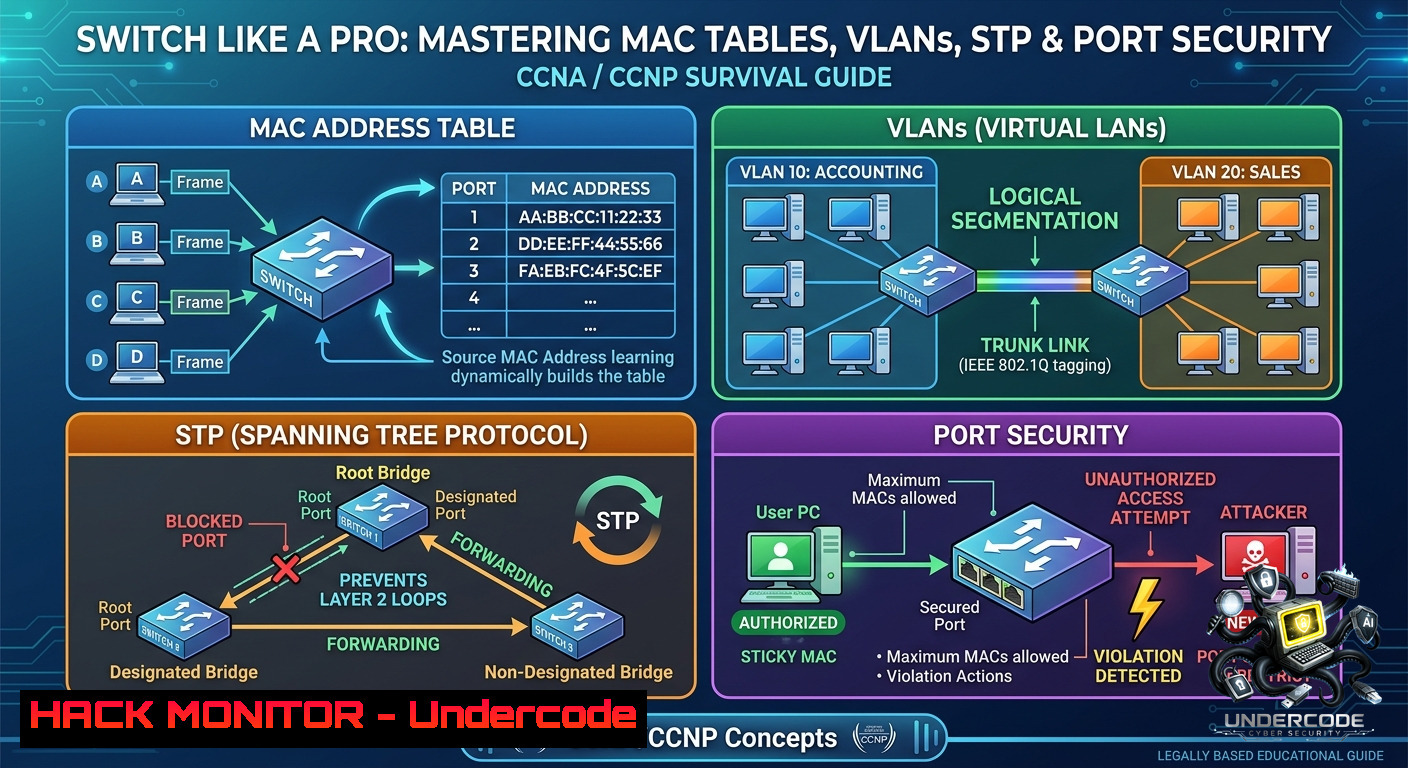
Switching is the heartbeat of any local area network, governing how data frames are forwarded based on MAC address tables and virtual LAN segmentation. Whether you are a network engineer securing enterprise trunks or a CCNA candidate battling spanning-tree loops, mastering switching concepts—MAC address tables, frame forwarding, VLANs, STP, port security, and trunking—is non‑negotiable for both operational efficiency and cyber resilience.
Learning Objectives:
– Understand how switches build and utilize the MAC address table for efficient frame forwarding.
– Configure and harden VLANs, trunk links, and Spanning Tree Protocol (STP) to prevent Layer 2 attacks.
– Implement port security features and Cisco‑specific commands to mitigate MAC flooding, CAM table overflow, and rogue switch threats.
You Should Know:
1. Inside the MAC Address Table & Frame Forwarding – A Step‑by‑Step Walkthrough
Switches learn MAC addresses by examining the source address of incoming frames and storing them in a Content Addressable Memory (CAM) table. When a frame arrives, the switch checks the destination MAC; if found, it forwards the frame only out the associated port (unicast). Unknown destinations trigger flooding to all ports except the incoming one.
How to inspect and manage the MAC table (Cisco IOS):
show mac address-table  View dynamic and static entries
clear mac address-table dynamic  Clear learned addresses
mac address-table static <MAC> vlan <id> interface <port>  Add static entry
Linux bridge equivalent (for virtual switches):
bridge fdb show  Show forwarding database (MAC table)
bridge fdb add <MAC> dev <bridge> port <port>  Static entry
ip link set <bridge> type bridge ageing_time 300  Set MAC aging
Windows perspective: Use `arp -a` to view IP‑to‑MAC mappings (host ARP cache, not switch CAM) and `netsh bridge show` for Windows network bridges.
Attack & mitigation: Attackers flood random MAC addresses (MAC flooding) to exhaust CAM table capacity, forcing the switch into fail‑open mode (hub‑like flooding). Mitigation: Enable port security and limit MAC learning per port.
2. VLAN Segmentation & Trunking Hardening – Isolate and Protect
VLANs break a single switch into multiple logical networks, improving security by isolating broadcast domains. Trunk ports (802.1Q) carry traffic from multiple VLANs between switches or to routers. Misconfigured trunks can lead to VLAN hopping attacks (double tagging or switch spoofing).
Step‑by‑step guide for secure trunk configuration (Cisco):
interface gig0/1
switchport mode trunk
switchport trunk encapsulation dot1q
switchport trunk allowed vlan 10,20,30  Explicit allow list – never use "allowed vlan all"
switchport nonegotiate  Disable DTP to prevent auto‑trunking
Hardening commands:
show interfaces trunk  Verify active trunks
vlan dot1q tag native  Tag native VLAN (prevents double‑tag attacks)
switchport trunk native vlan 999  Change native VLAN to unused ID
Linux bonding/trunking (for bridge + VLAN sub‑interfaces):
ip link add link eth0 name eth0.10 type vlan id 10  Create VLAN interface
bridge vlan show  Show VLAN mappings on bridge
Windows: Use `Set-1etLbfoTeam` for NIC teaming (trunk‑like aggregation), but VLAN tagging is limited.
Best practice: Always disable Dynamic Trunking Protocol (DTP) on access ports (`switchport mode access` and `switchport nonegotiate`).
3. Spanning Tree Protocol (STP) – Preventing Loops and Blocking Rogue Switches
STP (802.1D) blocks redundant links to prevent broadcast storms and MAC instability. However, an attacker can become root bridge (sending low‑priority BPDUs) or cause topology changes to degrade performance. Use STP security extensions.
Verify STP state (Cisco):
show spanning-tree brief  Root bridge, port roles (Root/Desig/Altn)
show spanning-tree vlan 1 detail
STP hardening:
spanning-tree vlan 1-4094 root primary  Force this switch as root (priority 24576)
interface gig0/1
spanning-tree portfast  For access ports (immediate forwarding)
spanning-tree bpduguard enable  Shutdown port upon BPDU reception
spanning-tree guard root  Prevent downstream switches from becoming root
Global protection:
spanning-tree loopguard default  Prevent alternate ports from becoming designated
errdisable recovery cause bpduguard  Auto‑recover shutdown ports
Linux STP (for bridge): STP is enabled by default on Linux bridges; control via `brctl stp
Attack scenario: An attacker connects a switch with lower bridge priority, becoming root and forcing all traffic through their device (man‑in‑the‑middle). Mitigation: `root guard` on ports that should never become root.
4. Port Security – Stopping MAC Flooding and CAM Table Exhaustion
Port security restricts the number of MAC addresses allowed on a switch port and specifies which MACs are legitimate. When a violation occurs, the port can shutdown, restrict, or protect.
Configure port security (Cisco access port):
interface fastEthernet 0/1
switchport mode access
switchport port-security
switchport port-security maximum 2  Only 2 MAC addresses allowed
switchport port-security violation shutdown  Shutdown on violation (requires manual recovery)
switchport port-security mac-address sticky  Dynamically learn and store MACs
Sticky MAC learning with aging:
switchport port-security aging time 10  Remove inactive MACs after 10 min
switchport port-security aging type inactivity
Verify and recover:
show port-security interface fastEthernet 0/1
errdisable recovery cause psecure-violation
errdisable recovery interval 300  Auto‑recovery after 5 min
Linux equivalent: Use `ebtables` or `tc` to filter MACs on bridges, but native port security is limited; switch hardware is preferred.
Windows: No direct port‑security at OS level; use 802.1X with NPS for network admission control.
5. Advanced Switching Defenses – BPDU Guard, Root Guard, and DHCP Snooping
Beyond basic STP and port security, modern switches offer integrated Layer 2 security services.
BPDU Guard + PortFast – Place on all end‑user access ports. Prevents rogue switch injection.
interface range gig0/1-24
spanning-tree portfast
spanning-tree bpduguard enable
Root Guard – Ensures designated ports do not become root ports. Use on ports connected to switches you do not trust to become root.
interface gig0/2
spanning-tree guard root
DHCP Snooping – Prevents rogue DHCP servers. Trust only uplink ports.
ip dhcp snooping
ip dhcp snooping vlan 10,20
interface gig0/1
ip dhcp snooping trust
interface gig0/2
ip dhcp snooping limit rate 10  Prevent DHCP starvation
Dynamic ARP Inspection (DAI) – Validates ARP packets against DHCP snooping database.
ip arp inspection vlan 10
interface gig0/1
ip arp inspection trust
Verification commands:
show ip dhcp snooping binding
show ip arp inspection vlan 10
show spanning-tree summary
What Undercode Say:
– Key Takeaway 1: Switching security is often overlooked in favor of firewalls and ACLs, yet misconfigured trunks and STP can hand an attacker full network visibility. Always enforce port security and BPDU guard on access ports.
– Key Takeaway 2: The MAC address table is both powerful and fragile – CAM table overflow turns your switch into a hub. Use sticky MAC limits and violation shutdowns to neutralize MAC flooding in seconds.
Analysis: The LinkedIn post by Sayed Hamza Jillani correctly highlights core switching pillars (MAC table, frame forwarding, VLAN, STP, port security, trunking) as essential for network engineers. However, it omits the attack vectors and mitigations that every security professional must know. Modern enterprises must extend these basics with DHCP snooping, DAI, and root guard to achieve Layer 2 resilience. Furthermore, the presence of a WhatsApp group (+923059299396, https://lnkd.in/d-kemJU6) indicates a training community – a practical resource for real‑time troubleshooting but one that should be vetted for security best practices.
Prediction:
– +1 Increased adoption of micro‑segmentation (VXLAN, EVPN) will reduce reliance on classic STP and VLAN hopping risks by 2028.
– -1 Attackers will continue exploiting misconfigured trunk native VLANs and STP root takeover in internal penetration tests, as switch hardening remains under‑prioritized.
– +1 Automation tools (Ansible, Nornir) will enforce switch port security templates at scale, drastically lowering human error in MAC limit and BPDU guard configurations.
– -1 Over‑reliance on port security aging without logging will leave incident responders blind to intermittent MAC spoofing attempts.
▶️ Related Video (74% Match):
🎯Let’s Practice For Free:
🎓 Live Courses & Certifications:
[Join Undercode Academy for Verified Certifications](https://undercode.co.uk/certifications/)
🚀 Request a Custom Project:
Secure, high-velocity infrastructure and disruptive technological engineering. Contact our engineering team for high-tier development and proprietary systems:
[[email protected]](mailto:[email protected])
💎 Smart Architecture | 🛡️ Secure by Design | ⭐ Trusted by Thousands
IT/Security Reporter URL:
Reported By: [Sayed Hamza](https://www.linkedin.com/posts/sayed-hamza-jillani-9a6b95204_switching-networking-ccna-share-7467140395001540608-mJ4X/) – Hackers Feeds
Extra Hub: Undercode MoN
Basic Verification: Pass ✅
🔐JOIN OUR CYBER WORLD [ CVE News • HackMonitor • UndercodeNews ]
[💬 Whatsapp](https://undercode.help/whatsapp) | [💬 Telegram](https://t.me/UndercodeCommunity)
📢 Follow UndercodeTesting & Stay Tuned:
[𝕏 formerly Twitter 🐦](https://x.com/undercodeupdate) | [@ Threads](https://www.threads.net/@undercodetesting) | [🔗 Linkedin](https://www.linkedin.com/company/undercodetesting/) | [🦋BlueSky](https://bsky.app/profile/undercode.bsky.social)


