Listen to this Post
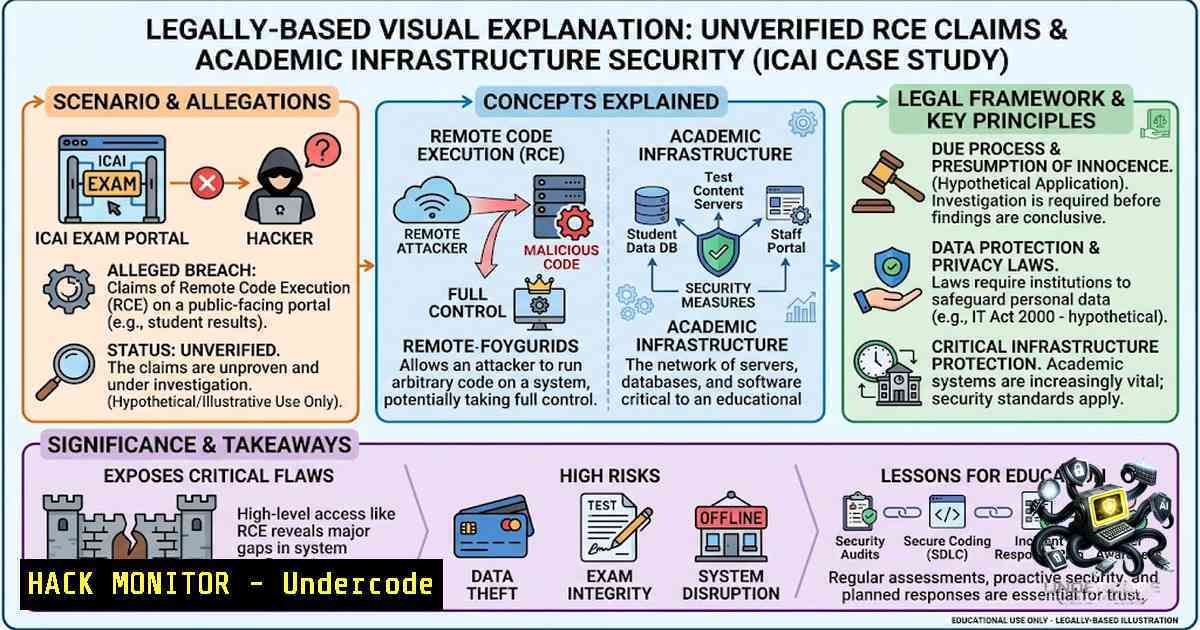
Introduction:
The Institute of Chartered Accountants of India (ICAI) found itself at the center of a cybersecurity storm just days before the scheduled announcement of CA Final and Intermediate examination results for May 2026. A threat actor operating under the alias “zowico” claimed to have achieved full Remote Code Execution (RCE) and super administrator access to the ICAI examiners portal. While Tata Consultancy Services (TCS), which maintains the examination data, has officially denied any breach, the allegations—ranging from access to student answer sheets to the ability to modify marks at the question level—have raised profound questions about the security posture of academic evaluation platforms and the systemic vulnerabilities that could enable such catastrophic compromises.
Learning Objectives:
- Understand the technical implications of Remote Code Execution (RCE) and super administrator privilege escalation in the context of examination platforms.
- Identify the attack vectors and security misconfigurations that could lead to the compromise of academic grading systems.
- Learn practical hardening techniques, vulnerability assessment methodologies, and incident response strategies to protect critical educational infrastructure.
You Should Know:
- Remote Code Execution (RCE) – The Attack Vector That Grants Keys to the Kingdom
Remote Code Execution represents one of the most severe classes of vulnerabilities in any web application. When a threat actor claims RCE capabilities on an examination portal, they are asserting the ability to execute arbitrary system commands on the underlying server infrastructure. This is not merely about data exfiltration—it is about complete system takeover.
Understanding RCE in Practice:
RCE vulnerabilities typically arise from improper input sanitization, insecure deserialization, or vulnerable third-party libraries. In the context of an examination platform like the ICAI examiners portal (http://examiners.icaiexam.icai.org), an attacker with RCE can:
– Upload and execute web shells for persistent access
– Dump database credentials and configuration files
– Modify application logic in real-time
– Pivot to internal networks and other connected systems
Linux Command Example – Simulating RCE Detection:
To identify potential RCE vectors in a web application, security professionals use tools like `nikto` and `nmap` NSE scripts:
 Scan for common RCE vulnerabilities
nikto -h http://examiners.icaiexam.icai.org -ssl -C all

Use Nmap to detect vulnerable services
nmap -sV --script=http-vuln -p 80,443 examiners.icaiexam.icai.org

Check for command injection points using curl
curl -X POST http://examiners.icaiexam.icai.org/api/upload \
-F "file=;id" --proxy http://127.0.0.1:8080
Windows Command Example – Web Shell Detection:
On Windows-based examination servers, administrators can monitor for suspicious processes:
 Detect unusual process executions indicative of RCE
Get-Process | Where-Object { $<em>.Path -like "temp" -or $</em>.Path -like "wwwroot" }

Check for suspicious scheduled tasks
schtasks /query /fo LIST /v | findstr /i "cmd powershell"

Audit IIS logs for anomalous POST requests
Select-String -Path "C:\inetpub\logs\LogFiles\W3SVC1.log" -Pattern ".php|.asp|cmd="
Mitigation Strategy:
To prevent RCE, organizations must implement:
- Strict input validation and output encoding
- Web Application Firewalls (WAF) with RCE signature detection
- Regular penetration testing and code reviews
- Principle of least privilege for application accounts
- Super Administrator Access – Privilege Escalation and the Insider Threat
The alleged super administrator access represents a complete breakdown of the access control model. Super administrator privileges in an examination platform would allow the attacker to bypass all security controls, modify user roles, and access sensitive functionalities reserved for platform operators.
Step-by-Step Guide – Auditing Super Administrator Accounts:
- Review All Administrative Accounts: Conduct a comprehensive inventory of all accounts with administrative privileges.
-- MySQL query to identify admin users
SELECT user_id, username, role, last_login, created_at
FROM users
WHERE role IN ('super_admin', 'admin', 'system_admin');
- Enable Multi-Factor Authentication (MFA): Mandate MFA for all administrative accounts. For Linux-based systems:
 Install Google Authenticator PAM module
apt-get install libpam-google-authenticator

Configure SSH to require MFA
echo "auth required pam_google_authenticator.so" >> /etc/pam.d/sshd
- Implement Privileged Access Management (PAM): Use tools like `sudo` with strict logging:
 Configure sudo to log all commands
echo "Defaults log_output" >> /etc/sudoers
echo "Defaults logfile=/var/log/sudo.log" >> /etc/sudoers

Monitor sudo usage
tail -f /var/log/sudo.log
- Conduct Regular Access Reviews: Implement a quarterly review process for all administrative accounts. Document justification for each super admin account.
-
Deploy Session Monitoring: Record and audit all administrative sessions using tools like `script` or commercial session recording solutions:
 Record all admin SSH sessions
mkdir -p /var/log/sessions
echo "session required pam_logs.so" >> /etc/pam.d/sshd
Windows Equivalent – Auditing Admin Access:
 List all members of the Domain Admins group
Get-ADGroupMember -Identity "Domain Admins" | Select-Object Name

Enable advanced audit logging
auditpol /set /category:"Logon/Logoff" /subcategory:"Special Logon" /success:enable /failure:enable

Review security event logs for privilege escalations
Get-WinEvent -LogName Security | Where-Object { $_.Id -in 4672, 4673, 4674 }
- Grade Manipulation – The Existential Threat to Academic Integrity
Perhaps the most damaging alleged capability is the ability to modify marks at both the question level and for entire answer scripts. Unlike traditional data breaches that expose information, grade manipulation attacks undermine the very foundation of academic certification.
Understanding the Attack Surface:
Grade manipulation can occur through:
- Direct database manipulation (SQL injection or direct access)
- Business logic flaws in the grading workflow
- Insecure API endpoints that accept unvalidated grade updates
- Compromised examiner accounts
Step-by-Step Guide – Securing Grading Workflows:
- Implement Immutable Audit Trails: Every grade modification must be logged with cryptographic integrity protection.
-- Create audit table with cryptographic hash
CREATE TABLE grade_audit (
audit_id SERIAL PRIMARY KEY,
student_id INT NOT NULL,
exam_id INT NOT NULL,
old_grade DECIMAL(5,2),
new_grade DECIMAL(5,2),
modified_by INT NOT NULL,
modification_timestamp TIMESTAMP DEFAULT CURRENT_TIMESTAMP,
hash_signature VARCHAR(256) NOT NULL,
ip_address INET,
user_agent TEXT
);
- Enforce Separation of Duties: No single individual should have the ability to both grade and modify grades without approval.
 Python example: Multi-party approval for grade changes
class GradeModification:
def <strong>init</strong>(self, student_id, exam_id, new_grade):
self.student_id = student_id
self.exam_id = exam_id
self.new_grade = new_grade
self.approvals = []
self.status = "pending"

def add_approval(self, approver_id, approver_role):
if approver_role not in ["exam_controller", "dean", "ombudsman"]:
raise ValueError("Insufficient authority")
self.approvals.append({"approver_id": approver_id, "role": approver_role})
if len(self.approvals) >= 3:
self.status = "approved"
- Implement Anomaly Detection: Monitor for unusual grade patterns using statistical analysis.
import pandas as pd
import numpy as np
from scipy import stats

Detect grade anomalies using Z-score
def detect_grade_anomalies(grades, threshold=3):
z_scores = np.abs(stats.zscore(grades))
anomalies = np.where(z_scores > threshold)[bash]
return anomalies

Example usage
exam_grades = pd.read_csv('exam_grades.csv')
anomalies = detect_grade_anomalies(exam_grades['grade'])
print(f"Potential grade anomalies: {len(anomalies)} records")
- Database Hardening: Restrict direct database access and implement row-level security.
-- PostgreSQL Row Level Security for grades table
ALTER TABLE grades ENABLE ROW LEVEL SECURITY;

CREATE POLICY grade_modification_policy ON grades
FOR UPDATE
USING (current_user = 'grade_admin' AND
EXISTS (SELECT 1 FROM approvals
WHERE approvals.grade_id = grades.id
AND approvals.status = 'approved'));
- API Security – The Overlooked Attack Surface in Examination Platforms
Modern examination platforms increasingly rely on APIs for functionality. Insecure APIs can expose sensitive endpoints for grade submission, result retrieval, and administrative functions.
Step-by-Step Guide – Securing Examination APIs:
- Inventory All API Endpoints: Document every API endpoint and its authentication requirements.
 Use OWASP ZAP to spider and enumerate APIs
zap-cli quick-scan -s all -t http://examiners.icaiexam.icai.org/api/

Use Burp Suite for manual API testing
 Configure Burp to intercept and analyze API traffic
- Implement API Rate Limiting: Prevent brute-force attacks and denial-of-service attempts.
 Flask example: Rate limiting for exam APIs
from flask_limiter import Limiter
from flask_limiter.util import get_remote_address

limiter = Limiter(
app,
key_func=get_remote_address,
default_limits=["100 per hour"]
)

@app.route('/api/exam/grade/<int:student_id>')
@limiter.limit("10 per minute")
def get_grade(student_id):
 Grade retrieval logic
pass
- Enforce Strong Authentication: Use OAuth 2.0 or JWT with short-lived tokens.
 JWT implementation with short expiry
import jwt
import datetime

def generate_token(user_id, role):
payload = {
'user_id': user_id,
'role': role,
'exp': datetime.datetime.utcnow() + datetime.timedelta(minutes=30),
'iat': datetime.datetime.utcnow()
}
return jwt.encode(payload, SECRET_KEY, algorithm='HS256')
- Validate All Input: Implement strict schema validation for all API requests.
 Pydantic schema for grade update
from pydantic import BaseModel, Field, validator

class GradeUpdateRequest(BaseModel):
student_id: int = Field(..., gt=0)
exam_id: int = Field(..., gt=0)
grade: float = Field(..., ge=0, le=100)
reason: str = Field(..., min_length=10, max_length=500)

@validator('grade')
def validate_grade(cls, v):
if v < 0 or v > 100:
raise ValueError('Grade must be between 0 and 100')
return v
- Log All API Access: Maintain detailed logs for forensic analysis.
import logging
import json
from datetime import datetime

def log_api_access(endpoint, user_id, request_data, response_status):
log_entry = {
'timestamp': datetime.utcnow().isoformat(),
'endpoint': endpoint,
'user_id': user_id,
'request': request_data,
'response_status': response_status,
'ip_address': request.remote_addr
}
logging.info(json.dumps(log_entry))
- Cloud Hardening – Protecting Examination Infrastructure in the Cloud
Many examination platforms are now hosted in cloud environments, introducing additional attack vectors related to misconfigured storage buckets, insecure IAM policies, and exposed management interfaces.
Step-by-Step Guide – Cloud Security Hardening:
- Review IAM Policies: Ensure least privilege access for all service accounts.
// AWS IAM Policy - Principle of Least Privilege
{
"Version": "2012-10-17",
"Statement": [
{
"Effect": "Deny",
"Action": [
"s3:DeleteBucket",
"s3:PutBucketPolicy",
"iam:"
],
"Resource": ""
},
{
"Effect": "Allow",
"Action": [
"s3:GetObject",
"s3:PutObject"
],
"Resource": "arn:aws:s3:::exam-data-bucket/",
"Condition": {
"StringEquals": {
"s3:prefix": ["public/", "grades/"]
}
}
}
]
}
- Enable CloudTrail and Monitoring: Implement comprehensive logging and alerting.
 AWS CLI - Enable CloudTrail
aws cloudtrail create-trail --1ame exam-platform-trail \
--s3-bucket-1ame exam-audit-logs \
--is-multi-region-trail

aws cloudtrail start-logging --1ame exam-platform-trail

Set up CloudWatch alarms for suspicious activity
aws cloudwatch put-metric-alarm --alarm-1ame "Unauthorized-API-Calls" \
--alarm-description "Alert on unauthorized API calls" \
--metric-1ame "UnauthorizedAttempts" \
--1amespace "AWS/CloudTrail" \
--statistic "Sum" \
--period 300 \
--evaluation-periods 1 \
--threshold 1 \
--comparison-operator "GreaterThanOrEqualToThreshold"
- Secure Storage Buckets: Prevent public exposure of sensitive examination data.
 AWS S3 - Block public access
aws s3api put-public-access-block \
--bucket exam-data-bucket \
--public-access-block-configuration \
BlockPublicAcls=true,IgnorePublicAcls=true,BlockPublicPolicy=true,RestrictPublicBuckets=true

Enable bucket encryption
aws s3api put-bucket-encryption \
--bucket exam-data-bucket \
--server-side-encryption-configuration \
'{"Rules": [{"ApplyServerSideEncryptionByDefault": {"SSEAlgorithm": "AES256"}}]}'
- Implement Network Segmentation: Use VPCs and security groups to isolate sensitive components.
 AWS - Create security group for exam database
aws ec2 create-security-group \
--group-1ame exam-db-sg \
--description "Security group for exam database" \
--vpc-id vpc-12345678

Allow only application tier access
aws ec2 authorize-security-group-ingress \
--group-id sg-12345678 \
--protocol tcp \
--port 5432 \
--source-group sg-application-tier
- Conduct Regular Cloud Security Assessments: Use tools like `Prowler` and `ScoutSuite` to identify misconfigurations.
 Install and run Prowler
git clone https://github.com/toniblyx/prowler
cd prowler
./prowler -M csv -z -S -c check_iam_password_policy,check_s3_bucket_public

Run ScoutSuite
scout.py aws --report-dir ./scout-reports --1o-browser
- Vulnerability Exploitation and Mitigation – Understanding the Attacker’s Playbook
Understanding how attackers exploit vulnerabilities is essential for building effective defenses. The alleged ICAI breach highlights several common attack patterns.
Common Exploitation Techniques:
- SQL Injection: Attackers can manipulate database queries to extract or modify grade data.
-- Vulnerable query example
SELECT  FROM students WHERE username = '$username' AND password = '$password';

-- Exploit: username = 'admin' OR '1'='1' --
-- Mitigation: Use parameterized queries
- Cross-Site Scripting (XSS): Attackers can inject malicious scripts to steal examiner session cookies.
// Vulnerable code
document.getElementById('output').innerHTML = user_input;

// Mitigation: Use textContent or sanitize input
document.getElementById('output').textContent = sanitize(user_input);
- Insecure Direct Object References (IDOR): Attackers can manipulate object identifiers to access unauthorized data.
 Vulnerable endpoint
@app.route('/api/grade/<int:student_id>')
def get_grade(student_id):
 No authorization check
return Grade.query.filter_by(student_id=student_id).first()

Mitigation: Implement authorization checks
@app.route('/api/grade/<int:student_id>')
@login_required
def get_grade(student_id):
if not current_user.can_access_student(student_id):
abort(403)
return Grade.query.filter_by(student_id=student_id).first()
Step-by-Step Guide – Conducting a Vulnerability Assessment:
1. Reconnaissance: Identify all exposed services and endpoints.
 Use Nmap for port scanning
nmap -sS -sV -p- -T4 examiners.icaiexam.icai.org

Use WhatWeb for technology fingerprinting
whatweb http://examiners.icaiexam.icai.org
- Automated Scanning: Run vulnerability scanners to identify known issues.
 Run OpenVAS scan
gvm-cli --gmp-username admin --gmp-password password \
socket --socketpath /var/run/gvmd.sock \
--xml "<create_task>...</create_task>"

Run Nikto for web server vulnerabilities
nikto -h http://examiners.icaiexam.icai.org -ssl -Format html -o scan-report.html
- Manual Testing: Perform targeted testing for business logic flaws.
 Intercept and modify requests using Burp Suite
 Use OWASP ZAP for active scanning
zap-cli active-scan -t http://examiners.icaiexam.icai.org
- Report and Remediate: Document findings and implement fixes with priority.
What Undercode Say:
- The credibility gap between social media claims and official denials underscores the critical need for independent technical validation in cybersecurity incidents. While TCS has denied any breach, the absence of a formal ICAI statement and the timing of the allegations—just days before major results—create an information vacuum that fuels speculation and erodes trust.
-
The alleged attack vector—RCE combined with super administrator access—represents a worst-case scenario for any web application. This combination would allow an attacker to not only exfiltrate data but also manipulate system behavior in real-time, making detection and remediation extraordinarily difficult. Organizations must prioritize defense-in-depth strategies that prevent such privilege escalations.
The incident, whether verified or not, serves as a powerful reminder that examination platforms are high-value targets. The ability to modify grades represents a direct attack on the integrity of professional certification, with far-reaching consequences for individuals, institutions, and the profession as a whole. The response from ICAI and TCS will be closely watched as a case study in incident communication and crisis management. The fact that the threat actor allegedly chose public disclosure over ransom suggests either a high level of confidence in the claims or a desire for notoriety rather than financial gain—both scenarios that demand serious attention from security professionals.
Prediction:
- +1 The heightened awareness from this incident will accelerate the adoption of zero-trust architectures and advanced threat detection in educational technology platforms across India and beyond.
-
-1 If the allegations are proven true, the reputational damage to ICAI and the CA certification process could be severe, potentially affecting the career prospects of thousands of students and the perceived value of the qualification.
-
+1 The incident will likely spur regulatory changes mandating stricter security standards for examination platforms, including mandatory third-party penetration testing and real-time monitoring requirements.
-
-1 The timing of the allegations, coinciding with critical result announcements, may lead to delays and confusion, causing significant stress for students who have invested years in their CA preparation.
-
+1 Security vendors will develop specialized solutions for academic integrity protection, creating a new market segment focused on preventing grade manipulation and examination fraud.
-
-1 If the threat actor’s claims of accessing over 200,000 records are verified, the resulting data breach could expose sensitive personal information of students and examiners, leading to identity theft and privacy violations.
-
+1 The incident will drive increased collaboration between educational institutions, cybersecurity firms, and government agencies to establish a national framework for examination security.
-
-1 The erosion of trust in online examination systems could lead to a temporary shift back to traditional paper-based examinations, increasing costs and logistical challenges.
-
+1 Organizations will invest more heavily in employee training and awareness programs, recognizing that human error remains the weakest link in cybersecurity defenses.
-
-1 The lack of transparency in the official response may lead to further speculation and conspiracy theories, undermining public confidence in the institution’s governance and security practices.
▶️ Related Video (78% Match):
https://www.youtube.com/watch?v=8lmwwJZBLw0
🎯Let’s Practice For Free:
🎓 Live Courses & Certifications:
Join Undercode Academy for Verified Certifications
🚀 Request a Custom Project:
Secure, high-velocity infrastructure and disruptive technological engineering. Contact our engineering team for high-tier development and proprietary systems:
[email protected]
💎 Smart Architecture | 🛡️ Secure by Design | ⭐ Trusted by Thousands
IT/Security Reporter URL:
Reported By: Vyankatesh Shinde – Hackers Feeds
Extra Hub: Undercode MoN
Basic Verification: Pass ✅


