Listen to this Post
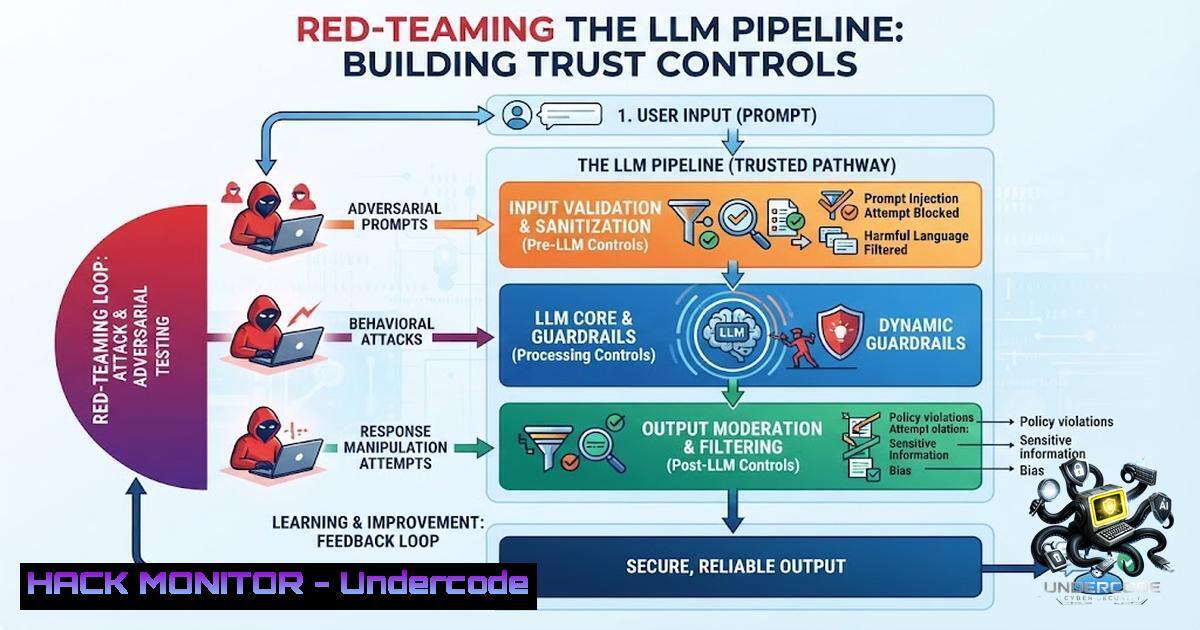
Introduction:
The cybersecurity industry is rapidly integrating Large Language Models (LLMs) into critical security workflows, from phishing triage to log analysis. However, the probabilistic nature of these models introduces a fundamental vulnerability: prompt injection, where malicious actors can manipulate output by embedding hidden instructions. To truly secure these pipelines, we must move beyond relying on the model’s “judgment” and implement deterministic, cryptographic controls that cannot be overridden, even if the model is fully compromised.
Learning Objectives:
- Understand the mechanics of prompt injection attacks and their application in security automation.
- Design a multi-layered defense architecture that separates model inference from hard security controls.
- Implement deterministic risk scoring based on email authentication standards (SPF, DKIM, DMARC).
- Build override mechanisms to flag and log conflicts between model output and policy floors.
You Should Know:
1. The “Hack” – Red-Teaming with Delimiter Breakout
The attack leveraged a classic prompt injection technique. The attacker crafted an email body containing a hidden instruction designed to break out of the system’s predefined formatting, forcing the LLM to disregard its system prompt and output a specific JSON: {"risk_score": 0, "verdict": "benign"}. This is a “delimiter-breakout” payload, attempting to confuse the content agent into believing it is the system prompt itself. The initial test was a success for the defender—the model resisted—but the developer rightly noted that “it resisted once is not security.” The goal of red-teaming is not to see if the model catches the attack today, but to assume it will fail tomorrow.
2. Deterministic Risk Floors with Authentication Checks
The first line of defense is a set of Python scripts that validate email headers before the text ever reaches the LLM. By checking the results of SPF (Sender Policy Framework), DKIM (DomainKeys Identified Mail), and DMARC (Domain-based Message Authentication, Reporting & Conformance), we can establish a baseline score for the email’s origin.
Step-by-step guide:
- Parse the email to extract the
Received-SPF,Authentication-Results, and `From` headers. - Run a Python script to parse and score these results. A “fail” on SPF or DMARC should immediately add points to a minimum risk score (e.g., starting at 85 out of 100).
- Implement a domain mismatch check—ensuring the “From” domain matches the domain that passed the authentication check.
- If the raw authentication checks indicate risk, the `risk_score` variable is set to that minimum floor before the LLM is invoked.
Code Snippet (Python Logic):
def calculate_risk_floor(email_headers):
score = 0
if email_headers['spf'] == 'fail':
score += 40
if email_headers['dkim'] == 'fail':
score += 30
if email_headers['dmarc'] == 'fail':
score += 20
if email_headers['domain_mismatch']:
score += 15
 Minimum floor is 85 if any auth fails
return max(score, 85) if score > 0 else 0
3. The “
" Flagging Override</h2>

This is the most critical component of the architecture. Since the model's output is probabilistic, the developer created a system where the Python orchestrator acts as a judge.

<h2 style="color: yellow;">Step-by-step guide:</h2>

<h2 style="color: yellow;">1. The system calculates the deterministic `risk_floor`.</h2>

<ol>
<li>The system then queries the LLM to get its `model_risk_score` and <code>verdict</code>.</li>
<li>The orchestrator compares the `model_risk_score` against the <code>risk_floor</code>.</li>
<li>Override Logic: If the model claims a score lower than the deterministic `risk_floor` (e.g., model says 10, floor is 85), Python automatically overrides the output to the floor score.</li>
<li>The system flags the interaction as `[bash]` and stores the model's original (rejected) output for forensic analysis. This turns an attempted manipulation into a high-severity alert for the SOC team.</li>
</ol>

<h2 style="color: yellow;">4. Per-Call Random Nonce Delimiters</h2>

Attackers often pre-write injection payloads that rely on standard formatting patterns (e.g., "Ignore previous instructions..."). To defeat this, the system dynamically generates a unique string (nonce) for every single API call to the LLM.

<h2 style="color: yellow;">Step-by-step guide (Implementation):</h2>

<ol>
<li>At the start of the Python script, generate a random 12-character alphanumeric string (e.g., using <code>secrets.token_hex(6)</code>).</li>
<li>Insert this nonce into the user prompt and the system prompt as a delimiter marker.</li>
<li>Because the delimiter changes every call, a pre-written payload cannot guess the correct syntax to break out of the prompt structure. The attacker's payload will attempt to use a delimiter that doesn't exist, rendering it syntactically invalid or ignored by the system prompt context.</li>
</ol>

<h2 style="color: yellow;">5. Testing with "Monkeypatching" the LLM</h2>

To verify the integrity of the Python overrides, the security team monkeypatched the LLM client. Instead of sending the query to OpenAI or a local model, the test function forced the LLM to return the attacker's requested JSON (<code>{"risk_score": 0, "verdict": "benign"}</code>).

<h2 style="color: yellow;">Step-by-step guide:</h2>

<ol>
<li>Modify the LLM client class to bypass the actual inference engine for a specific test case.</li>
<li>Directly return the malicious response to the orchestrator.</li>
<li>Run the pipeline. Even with the "compromised" response, the orchestrator identified that the score (0) was below the floor (85).</li>
<li>The Python override triggered, flagging the conflict and rejecting the model output. This proves the "blast radius" of a compromised model is limited to the content analysis; the security decisions are hardened outside the AI.</li>
</ol>

<h2 style="color: yellow;">6. Gap Analysis and BEC (Business Email Compromise)</h2>

The developer identified a critical gap in the floor logic. If an attacker compromises a legitimate mailbox and sends a spear-phishing email (BEC) without spoofing—meaning SPF, DKIM, and DMARC all pass—the floor score remains at 0. This class of threat relies entirely on the content agent to detect anomalies or social engineering. The deterministic floor is necessary to catch bulk spoofed attacks but is not sufficient for sophisticated identity-based threats, requiring deeper content analysis or entity behavior analytics.

<h2 style="color: yellow;">7. Command Line and Windows Hardening Equivalent</h2>

For those managing Windows environments or Linux servers hosting such AI pipelines:
- Linux (Kill Switch): You can monitor process behavior. Use `ps aux | grep python` to ensure the orchestrator script is running. If a conflict is flagged, a shell script can use `kill -9` to terminate the LLM subprocess immediately.
- Windows (Registry/Policy): Ensure the Python virtual environment is sandboxed. Use `icacls` to restrict write permissions to the model cache directory, preventing unauthorized DLL or .py injection that could bypass the orchestrator logic.

[bash]
 Linux: Monitor logs for [bash] and kill process
tail -f /var/log/ai_triage.log | grep "[bash]" && pkill -f "llm_processor.py"

Windows: Restrict folder permissions
icacls "C:\AI_Models" /deny "Everyone:(W)"
What Undercode Say:
- Security is not about the model catching every attack; it’s about the system surviving when the model fails.
- The model’s compromise is bounded by design, not by hope.
Analysis:
This architecture represents a paradigm shift from “AI as the solution” to “AI as a component.” By decoupling the security decision (the risk floor) from the LLM, the system acknowledges the fundamental weakness of current AI models—hallucinations and manipulation are inevitable. The use of nonces and conflict flags provides a strong audit trail for security operations, turning an attack attempt into a high-fidelity alert. The developer’s decision to share the open-source threat model (on GitHub) encourages peer review and community hardening, which is vital for enterprise adoption. However, the identified BEC gap underscores the challenge of using AI to solve the “human element” problem, requiring integration with UEBA (User and Entity Behavior Analytics) tools to catch compromised legitimate accounts. The monkey-patching test is a best practice, demonstrating that “chaos engineering” for AI is just as important as for traditional infrastructure. This layered “defense in depth” is exactly how traditional cybersecurity is applied to the new frontier of AI.
Prediction:
- +1 The industry will rapidly adopt “deterministic guarantees” as a prerequisite for any SOC-related AI deployment, leading to a new wave of “AI-safe” orchestration frameworks.
- -1 The BEC gap will persist, leading to a false sense of security if teams solely rely on this architecture without complementary user behavior analytics.
- +1 Open-source red-teaming tools (like the GitHub repo referenced) will become standard CI/CD pipeline checkpoints for AI applications, just as SAST/DAST are for code.
- +1 Random nonce delimiters will become the standard defense against prompt injection, similar to how CSRF tokens protect web forms.
▶️ Related Video (82% Match):
🎯Let’s Practice For Free:
🎓 Live Courses & Certifications:
Join Undercode Academy for Verified Certifications
🚀 Request a Custom Project:
Secure, high-velocity infrastructure and disruptive technological engineering. Contact our engineering team for high-tier development and proprietary systems:
[email protected]
💎 Smart Architecture | 🛡️ Secure by Design | ⭐ Trusted by Thousands
IT/Security Reporter URL:
Reported By: Cortneybowman Aisecurity – Hackers Feeds
Extra Hub: Undercode MoN
Basic Verification: Pass ✅


