Listen to this Post
Introduction:
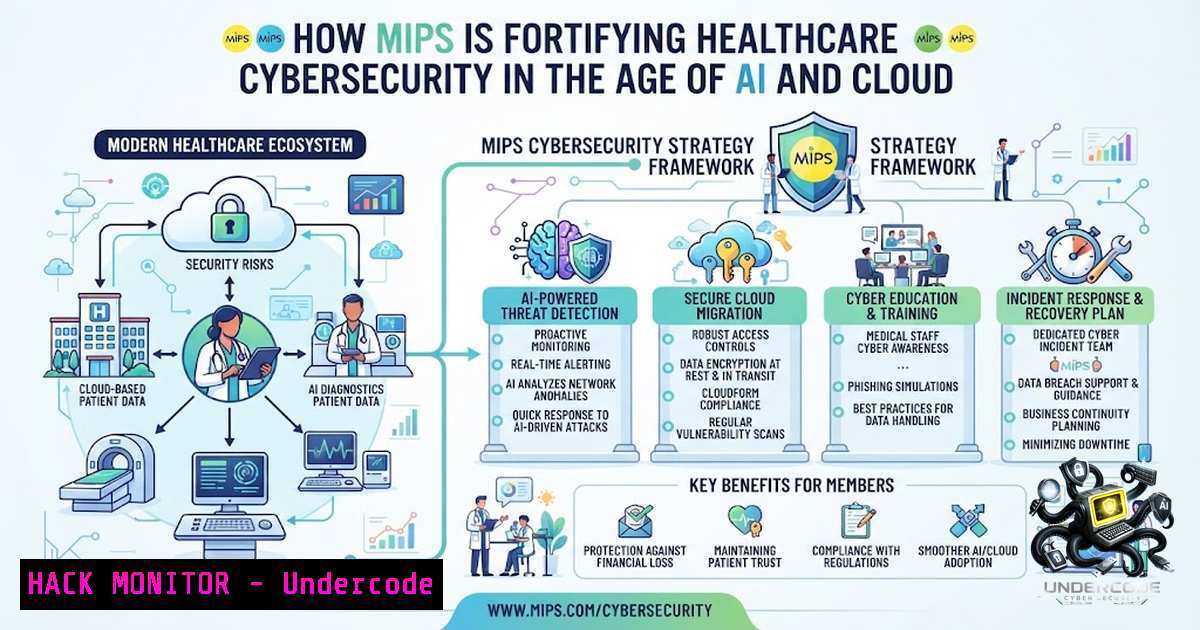
As healthcare organisations increasingly migrate to cloud infrastructures and integrate artificial intelligence into clinical and operational workflows, the attack surface for cyber adversaries expands exponentially. The Medical Indemnity Protection Society (MIPS), an Australian membership organisation providing indemnity insurance for healthcare practitioners, stands at the intersection of this digital transformation and the escalating threat landscape. With healthcare data breaches accounting for 22% of all cybersecurity incidents and cybercrime reported every ten minutes in Australia, MIPS’s strategic adoption of cloud-1ative security solutions and its commitment to responsible AI governance offer a blueprint for protecting sensitive medical information while celebrating cultural milestones like NAIDOC Week’s 50 Years of Deadly theme.
Learning Objectives:
- Understand the shared responsibility model in cloud security and how organisations like MIPS protect Microsoft 365 data against accidental or malicious deletion.
- Identify key AI-specific cyber threats—including data poisoning, model drift, and adversarial attacks—and learn governance frameworks to mitigate them.
- Master practical Linux and Windows commands for healthcare IT security, backup verification, and compliance auditing.
You Should Know:
- Cloud-1ative Data Resilience: MIPS’s Journey from Legacy to SaaS Protection
MIPS’s technology transformation began with a strategic move from maintenance-intensive legacy IT systems to Microsoft 365 and Azure cloud. However, this migration introduced new challenges: protecting cloud information in a compliant and cost-effective manner under Microsoft’s shared responsibility model, which places the onus on customers to safeguard their long-term data. As Lucian Burns, Head of Technology at MIPS, explained, “We were falling short on protections like backup and data management. From a regulatory and compliance perspective, we needed a more comprehensive recovery solution”.
After evaluating market solutions with guidance from Gartner, MIPS selected the Druva Data Resiliency Cloud—a cloud-1ative SaaS platform that delivers 100% protection and point-in-time recovery for Microsoft 365 data. The solution’s intuitive interface, transparent pricing, and minimal administrative overhead enabled MIPS to restore files in-place, elsewhere, or via download with exceptional ease.
Step‑by‑step guide: Verifying Microsoft 365 Backup Integrity (Linux/Windows)
To ensure your cloud backups are recoverable, regular verification is essential. Below are commands for Linux and Windows to test backup integrity and simulate recovery scenarios.
Linux (using `curl` and `jq` for API checks):
 Check Druva backup status via API (replace with your endpoint and token)
curl -X GET "https://api.druva.com/backup/status" \
-H "Authorization: Bearer YOUR_API_TOKEN" \
-H "Content-Type: application/json" | jq '.data[].last_backup_time'

Simulate a file restore to a test directory
mkdir -p /tmp/restore_test
druva-cli restore --file "/path/to/important.docx" --time "2026-07-01T00:00:00Z" --output /tmp/restore_test/
Windows (PowerShell):
 Check Microsoft 365 backup status using Graph API
$token = "YOUR_ACCESS_TOKEN"
$uri = "https://graph.microsoft.com/v1.0/sites/root/drive/root"
$headers = @{Authorization = "Bearer $token"}
Invoke-RestMethod -Uri $uri -Headers $headers | Select-Object -Property lastModifiedDateTime

Test SharePoint site recovery point
Test-SPOSite -Identity "https://yourtenant.sharepoint.com/sites/mips" -RecoveryPoint (Get-Date).AddDays(-7)
- AI Governance in Healthcare: Securing the Intelligent Ecosystem
MIPS takes the safe and responsible use of Artificial Intelligence seriously, guided by a commitment to protecting members and upholding the highest professional and ethical standards. This aligns with the Health Sector Coordinating Council’s (HSCC) newly published “Health Industry AI Cyber Governance Framework Implementation Guide” (June 2026), which addresses cybersecurity and privacy challenges across the full spectrum of AI technologies—from traditional machine learning models to generative and agentic AI systems capable of autonomous action.
Key AI-specific risks include data poisoning (where attackers corrupt training data), model drift (where performance degrades over time), and adversarial attacks that manipulate AI outputs. Healthcare organisations must integrate AI-specific risk assessments into existing cybersecurity frameworks and secure the AI supply chain.
Step‑by‑step guide: Implementing AI Model Security Monitoring
Linux (using `openssl` and `auditd` for model integrity checks):
 Generate cryptographic hash of your AI model file to detect tampering
sha256sum /path/to/your_model.h5 > model_hash.txt
 Set up a cron job to verify daily
echo "0 2    sha256sum -c model_hash.txt >> /var/log/model_integrity.log" | crontab -

Monitor API calls to your AI endpoint for anomalous patterns
sudo auditctl -w /var/log/ai_api.log -p rwxa -k ai_api_monitor
Windows (PowerShell):
 Calculate file hash for AI model
Get-FileHash -Path "C:\Models\diagnostic_model.onnx" -Algorithm SHA256 | Out-File -FilePath "model_hash.txt"

Set up a scheduled task to verify model integrity daily
$action = New-ScheduledTaskAction -Execute "PowerShell.exe" -Argument "-Command Get-FileHash -Path C:\Models\diagnostic_model.onnx -Algorithm SHA256 | Compare-Object (Get-Content model_hash.txt)"
$trigger = New-ScheduledTaskTrigger -Daily -At 2am
Register-ScheduledTask -Action $action -Trigger $trigger -TaskName "AI_Model_Integrity_Check"
- Cyber Resilience for Healthcare Practices: Threats and Mitigations
Healthcare organisations are prime targets for cybercriminals due to the high value of sensitive information, including contact details, dates of birth, and medical histories that can be used for identity theft or extortion. MIPS identifies key threats including ransomware, data breaches via social engineering, DDoS attacks, phishing, and insider threats. Notably, MIPS’s indemnity insurance covers professional practice but does not comprehensively cover cyber liability; members are advised to obtain separate practice entity and cyber cover through partners like Aon.
The Australian Cyber Security Centre (ACSC) reports that criminal data breaches make up nearly two-thirds of all reported incidents, with healthcare experiencing one in ten attacks. Implementing robust cyber hygiene—including strong password policies, multi-factor authentication, and regular security awareness training—is critical.
Step‑by‑step guide: Hardening Healthcare IT Infrastructure
Linux (firewall configuration and intrusion detection):
 Configure UFW to allow only essential ports
sudo ufw default deny incoming
sudo ufw default allow outgoing
sudo ufw allow 22/tcp  SSH (restrict to trusted IPs)
sudo ufw allow 443/tcp  HTTPS
sudo ufw enable

Install and configure Fail2ban for brute-force protection
sudo apt-get install fail2ban -y
sudo systemctl enable fail2ban
sudo systemctl start fail2ban

Set up AIDE (Advanced Intrusion Detection Environment)
sudo aideinit
sudo mv /var/lib/aide/aide.db.new.gz /var/lib/aide/aide.db.gz
sudo aide --check
Windows (PowerShell – security hardening and logging):
 Enable advanced audit logging
auditpol /set /subcategory:"Logon" /success:enable /failure:enable
auditpol /set /subcategory:"File System" /success:enable /failure:enable

Configure Windows Defender Firewall
New-1etFirewallRule -DisplayName "Block RDP except trusted IP" -Direction Inbound -Protocol TCP -LocalPort 3389 -Action Block
New-1etFirewallRule -DisplayName "Allow RDP from trusted subnet" -Direction Inbound -Protocol TCP -LocalPort 3389 -RemoteAddress 192.168.1.0/24 -Action Allow

Enforce password complexity
secedit /export /cfg c:\secpol.cfg
(Get-Content c:\secpol.cfg) -replace 'PasswordComplexity = 0', 'PasswordComplexity = 1' | Set-Content c:\secpol.cfg
secedit /configure /db c:\windows\security\local.sdb /cfg c:\secpol.cfg /areas SECURITYPOLICY
- Compliance and Regulatory Frameworks: MIPS and HIPAA Alignment
MIPS operates in a stringent regulatory environment with overheads equivalent to large insurers. The organisation’s commitment to compliance extends to annual Security Risk Analyses (SRA) for electronic Protected Health Information (ePHI), aligning with both MIPS and HIPAA standards. Regular SRAs evaluate potential risks and implement necessary safeguards to address vulnerabilities, boosting Merit-based Incentive Payment System scores.
Step‑by‑step guide: Conducting a Security Risk Analysis
Linux (using `nmap` and `nikto` for vulnerability scanning):
 Network scan to identify active devices and open ports
nmap -sV -p- -T4 192.168.1.0/24 > network_audit.txt

Web server vulnerability scan
nikto -h https://your-healthcare-portal.com -output web_vulns.txt

Check for outdated packages with known vulnerabilities
sudo apt-get update && sudo apt-get upgrade --dry-run | grep -i security
Windows (PowerShell – using built-in tools):
 Run Windows Defender Offline Scan for malware
Start-MpWDOScan

Check for missing security patches
Get-HotFix | Where-Object {$_.InstalledOn -lt (Get-Date).AddDays(-30)} | Select-Object HotFixID, InstalledOn

Audit local group policy settings for compliance
secedit /export /cfg c:\gp_audit.cfg
Select-String -Path c:\gp_audit.cfg -Pattern "MaximumPasswordAge","MinimumPasswordLength"
- AI-Powered Threat Detection: The Future of Healthcare Security
Traditional signature-based security tools struggle against modern threats like living-off-the-land techniques and lateral movement. AI-driven security platforms, however, analyse behaviour patterns across networks, detecting anomalies and unknown threats in real time. These tools reduce alert fatigue by prioritising genuine threats, enabling understaffed security teams to respond effectively. As AI adoption accelerates, organisations that pair AI with human oversight and deep observability are better positioned to protect patient data and meet compliance requirements.
Step‑by‑step guide: Deploying AI-Based Anomaly Detection
Linux (using Python and `scikit-learn` for basic anomaly detection):
 Install required libraries
 pip install scikit-learn pandas numpy

import pandas as pd
from sklearn.ensemble import IsolationForest

Load network traffic logs
data = pd.read_csv('/var/log/network_traffic.csv')
model = IsolationForest(contamination=0.01)
model.fit(data[['bytes_sent', 'bytes_recv', 'duration']])
data['anomaly'] = model.predict(data[['bytes_sent', 'bytes_recv', 'duration']])
anomalies = data[data['anomaly'] == -1]
print(f"Detected {len(anomalies)} anomalous sessions")
Windows (PowerShell – leveraging Azure AI services):
 Invoke Azure AI Anomaly Detector API
$body = @{
"series" = @(
@{ "timestamp" = "2026-07-01T00:00:00Z"; "value" = 120 },
@{ "timestamp" = "2026-07-01T01:00:00Z"; "value" = 450 }
)
} | ConvertTo-Json
$response = Invoke-RestMethod -Method Post -Uri "https://your-azure-endpoint.cognitiveservices.azure.com/anomalydetector/v1.0/timeseries/entire/detect" -Body $body -ContentType "application/json" -Headers @{"Ocp-Apim-Subscription-Key"="YOUR_KEY"}
$response | Select-Object -ExpandProperty expectedValues
What Undercode Say:
- Key Takeaway 1: MIPS’s strategic pivot to Druva’s cloud-1ative backup solution demonstrates that even regulated industries can achieve resilient, scalable data protection without overwhelming IT resources. The proof-of-concept approach ensured return on value before full deployment.
-
Key Takeaway 2: The intersection of AI governance and healthcare cybersecurity is no longer optional. With HSCC frameworks now available, organisations must proactively address AI-specific risks—from data poisoning to adversarial attacks—to maintain patient trust and regulatory compliance.
Analysis: The healthcare sector’s digital transformation, accelerated by cloud adoption and AI integration, demands a fundamental shift in cybersecurity strategy. MIPS’s journey from legacy systems to a SaaS-based resilience model underscores the importance of aligning technology choices with regulatory requirements and operational realities. The emergence of AI-specific threats, coupled with the sector’s attractiveness to cybercriminals, necessitates continuous investment in both technology and workforce training. As NAIDOC Week celebrates 50 years of Indigenous strength and resilience, the healthcare community must similarly demonstrate resilience in protecting the data and wellbeing of all Australians, including Aboriginal and Torres Strait Islander peoples. The path forward lies in embracing AI-powered defences, maintaining rigorous compliance practices, and fostering a culture of cyber awareness across every level of healthcare delivery.
Prediction:
- +1 The adoption of AI-driven threat detection will reduce healthcare data breach response times by over 60% within the next two years, significantly mitigating financial and reputational damage.
-
+1 Cloud-1ative backup solutions like Druva will become the industry standard for healthcare organisations, driven by regulatory demands for point-in-time recovery and immutable storage.
-
-1 The sophistication of AI-enabled cyberattacks—including automated phishing and adaptive malware—will outpace traditional defence mechanisms, leading to a temporary spike in successful breaches before AI governance frameworks mature.
-
-1 Healthcare organisations that delay implementing comprehensive AI risk assessments will face increased regulatory scrutiny and potential penalties, particularly as HSCC guidance becomes incorporated into compliance standards.
-
+1 Cross-sector collaboration, exemplified by HSCC’s 500-member working group, will accelerate the development of standardised AI cybersecurity terminology and best practices, reducing ambiguity and improving sector-wide resilience.
▶️ Related Video (74% Match):
https://www.youtube.com/watch?v=2jU-mLMV8Vw
🎯Let’s Practice For Free:
🎓 Live Courses & Certifications:
Join Undercode Academy for Verified Certifications
🚀 Request a Custom Project:
Secure, high-velocity infrastructure and disruptive technological engineering. Contact our engineering team for high-tier development and proprietary systems:
[email protected]
💎 Smart Architecture | 🛡️ Secure by Design | ⭐ Trusted by Thousands
IT/Security Reporter URL:
Reported By: Naidoc2026 Naidocweek – Hackers Feeds
Extra Hub: Undercode MoN
Basic Verification: Pass ✅


